
Underwriting a duplex house hack comes down to eleven inputs in and six outputs out: price, down payment, rate, term, taxes, insurance, mortgage insurance, rent from the other units, your unit’s future market rent, vacancy and a maintenance reserve. Those produce your total payment, effective housing cost, gross rent, cash flow, cash-on-cash return and cap rate. Skipping the reserves only hides what the deal does.
If you’re new to house hacking, the complete guide to what house hacking is gives you the overview before these numbers.
11 inputs, 6 outputs, and the lies most house-hack content tells.
Most house-hack content shows you the headline, “your tenant pays your mortgage!”, and then ushers you toward a course, a coaching call, or a comment-section pep rally. What it skips is the arithmetic that determines whether a specific duplex deal works.
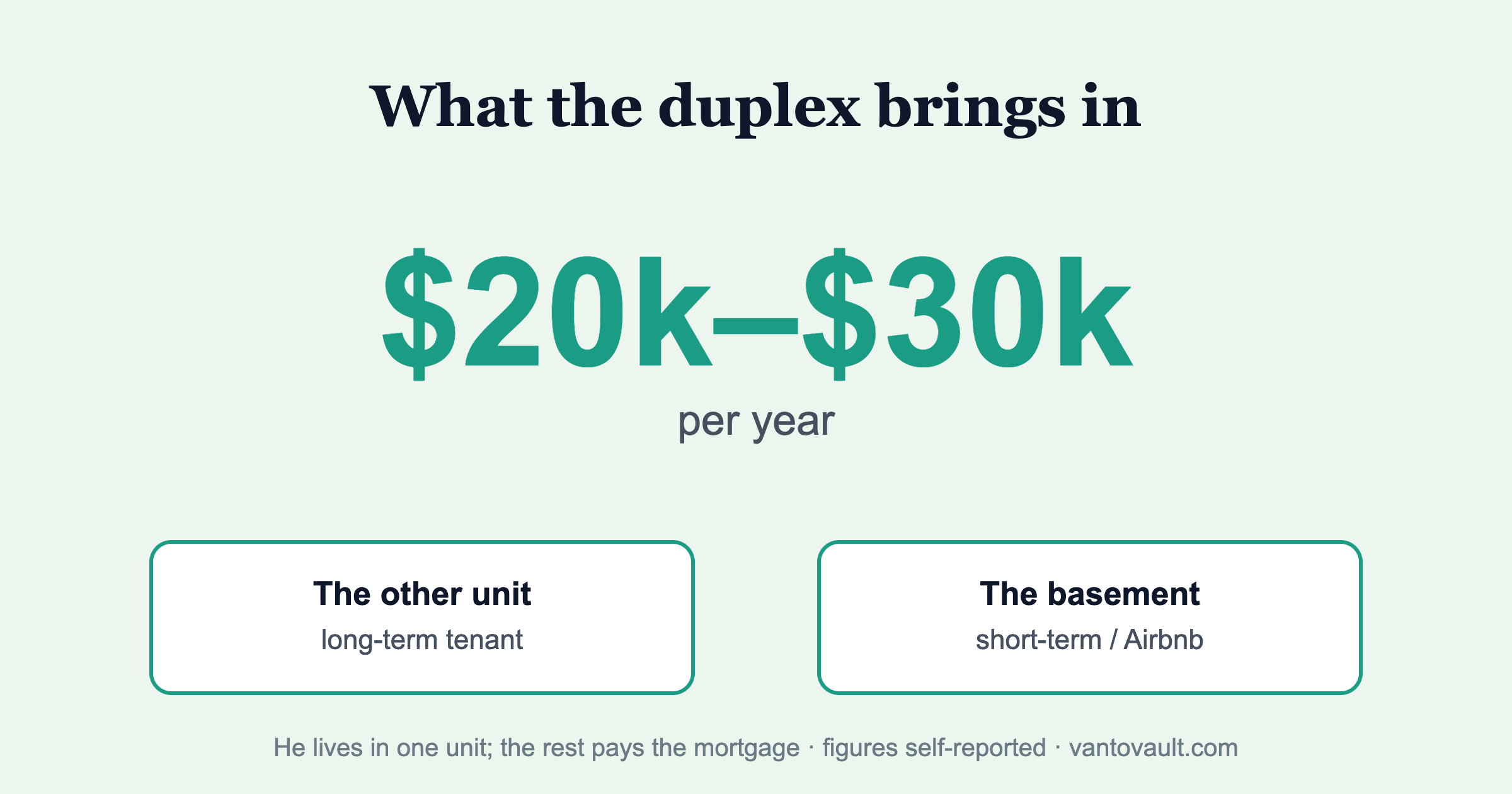
I bought a duplex with an FHA loan in the Midwest, live in one unit, and rent out the other plus a basement short-term rental. After I closed on it, I built the calculator on this site so other people could run the same math without rebuilding a spreadsheet from scratch.
Before I closed on that property, I ran the numbers on hundreds of listings.
This post walks through that math the way I actually do it. Eleven inputs in. Six outputs out. And the five places where most house-hack content lies to you about what those numbers really mean.
If you want to follow along on a real listing, open the calculator in another tab. We’ll use the same fields.
Example duplex listing used for these numbers
Let’s use a representative duplex listing, the kind you’d actually find on Zillow in a healthy small-multi market today:
- Price: $350,000
- Property type: Side-by-side duplex, two 2-bed/1-bath units, ~2,200 sqft total
- Condition: Lived-in. Roof is 12 years old. Boiler is original. One unit is currently rented at market; the other will be your owner-occupied unit.
- Location: A working-class neighborhood in a midsize Midwestern city
This is not a glamorous deal. It is a normal one. If you’re trying to house-hack on an FHA loan, glamorous is rarely on the menu.
Now the math.
The 11 inputs a duplex analysis needs
These are the only inputs you need to properly underwrite a small-multi deal. If a calculator asks you for more, it’s probably padding. If it asks for fewer, it’s hiding something.
Property & financing (7)
- Purchase price. $350,000 in our example. Use the asking price for a first pass, then re-run with what you’d actually offer.
- Down payment percentage. With an FHA loan on an owner-occupied small multi, the floor is 3.5% with a credit score of 580 or higher (10% from 500 to 579).[S1] With a conventional loan, you’re usually at 5–15%. House-hack content often shows the 3.5% example without explaining what that costs you in PMI/MIP for the rest of your life. We’ll get to that.
- Interest rate. Use the current rate for owner-occupied financing on small multi-units in your area. Rates change weekly, so always pull live numbers, not a number you remember.
- Loan term. 30 years for almost everyone reading this.
- Annual property tax. Look it up on the county assessor’s website. Don’t trust the Zillow estimate, which is often a stale number from when the property last sold.
- Annual insurance. Get a real quote, not a Google average. Multi-family insurance on a property you’ll partially rent is meaningfully more expensive than single-family insurance on a comparable home.
- Monthly PMI/MIP. On an FHA loan with less than 10% down, MIP runs about 0.55% of your loan balance annually. On a $337,750 FHA loan that’s roughly $155/month, and it’s permanent for the life of the loan. On a conventional loan with less than 20% down, PMI is usually cheaper and drops off when you hit 20% equity.
Rental income (2)
- Total monthly rent from other units (while you live there). Pull this from current leases if it’s in place, or from Rentometer / actual local listings if you’ll be re-renting.
- Your unit’s market rent (after you move out). This matters because the deal isn’t only about year one. Most house-hackers move out within 2–5 years. The deal needs to work as a pure rental too.
Operating assumptions (4, but two are inputs, two are reality checks)
- Vacancy rate. Use 5% in a healthy market, 8% in a softer one. (Yes, you should model vacancy even if your current tenants seem stable. They will eventually leave.)
- Maintenance & CapEx reserve. 8% of rent at a bare minimum. 10–15% on older properties. This is where most house-hack content lies the hardest.
(There’s also property management and closing costs, we’ll handle those when we calculate outputs.)

The 6 outputs that actually tell you whether the deal works
You ran the 11 inputs through the calculator. This is what comes out, and how to read each number.
1. Total monthly housing cost (PITI)
Principal + interest + taxes + insurance + (PMI/MIP if applicable). This is what hits your bank account every month if there were no rental income.
In our $350K example with 3.5% down FHA and current rates, you’re looking at roughly $2,800–$3,000/month all-in. Don’t quote me on the exact number, pull live rates.
2. Your effective housing cost while owner-occupied
This is PITI minus what your tenant is paying you. In a healthy small-multi market, the other unit rents for $1,400–$1,700/month. So your out-of-pocket housing cost is roughly $1,100–$1,600/month, meaningfully less than a comparable apartment in the same metro.
This is the number most house-hack content waves around. It’s a real number. But it’s not the whole picture.
3. Gross monthly rent (after you move out)
Both units rented at market. In our example, two units at ~$1,500 each = $3,000/month gross.
4. Net monthly cash flow (after debt service)
Gross rent, minus vacancy reserve, minus maintenance & CapEx, minus property management, minus PITI = your actual monthly cash flow.
On our example, full rental mode runs about -$430 to -$630/month once you use the walkthrough assumptions below: 5% vacancy, 8% maintenance and 8% management take $630 off the $3,000 gross, leaving $2,370 against a payment of $2,800 to $3,000. That’s normal for a house-hack-to-rental conversion in a current-rates environment, and it’s why owner-occupied financing is the lever that makes this category work, you’re banking the housing-cost savings during your live-in years, not the cash flow.
5. Cash-on-cash return
Annual cash flow / total cash invested (down payment + closing costs). On a house-hack deal you can move into for 3.5–5% down, this number is often unimpressive in year one and gets better as rents grow. Don’t fixate on year-one cash-on-cash, it doesn’t capture the housing-cost arbitrage.
6. Cap rate
Net operating income (annual rent minus operating expenses, before debt service) divided by purchase price. This is the “if I bought this property with cash, what return would I get from operations alone” number.
For small multi-units bought with FHA today, you’ll typically see cap rates in the 4–7% range. Below 4% and the deal needs to lean hard on appreciation or rent growth. Above 7% and you should be asking why it’s that high, there’s usually a reason, and it’s usually a reason that costs money.
| Output | What it means | Amount |
|---|---|---|
| Total payment (PITI) | Principal, interest, taxes, insurance and FHA mortgage insurance | $2,800 to $3,000 |
| Rent from the other unit | What the tenant pays while you live on the other side | $1,400 to $1,700 |
| Your cost after that rent | What actually leaves your account each month | $1,100 to $1,600 |
| Gross rent after you move out | Both units at about $1,500 each | $3,000 |
| Cash flow after you move out | What is left once reserves and the payment come out | -$430 to -$630 |
The five lies most house-hack content tells
This is the part you won’t find in the influencer version.
Lie #1: “Vacancy is rare, so you can skip the reserve.”
It is rare until it isn’t. A 5% vacancy reserve costs you $75/month on a unit that rents for $1,500. Skipping it doesn’t make your deal better, it just hides what your deal actually does. Build the reserve in. If you never use it, congratulations: you have a vacancy fund. If you do use it, you’re not surprised by a $1,500 month with zero rent.
Lie #2: “Maintenance is minor on a starter property.”
Anything you can buy with FHA money in a normal market is at least 30 years old, and usually older. The roof has a date on it. The boiler has a date on it. The water heater has a date on it. The electrical panel has a date on it. The math doesn’t care if you’re a first-time investor. Use 10–15% of rent for maintenance and CapEx if the property has any age on it, and don’t apologize for it.
Gross rent is not cash flow. Net rent is not cash flow. Cash flow is net rent minus your debt service.
Lie #3: “I’ll manage it myself, so management is free.”
Fine. While you live there, it’s basically free. But model what your cash flow looks like with 8–10% of rent going to property management, because the day you move out and don’t want to take 3 a.m. phone calls is the day this expense becomes real. A deal that works on paper only because you’re working a second unpaid job isn’t a deal. It’s a job.
Lie #4: “PMI drops off after a few years.”
On a conventional loan, sure. On FHA with less than 10% down, MIP is for the life of the loan, full stop. You can refinance out of it eventually, but only if rates cooperate and your equity has grown. Model MIP as permanent in your underwriting. Be pleasantly surprised if you can refi out of it later.
Lie #5: “Just look at gross rent.”
Gross rent is not cash flow. Net rent is not cash flow. Cash flow is net rent minus your debt service. You will see gross rent quoted on Instagram all the time. You will rarely see actual cash flow quoted, because actual cash flow on a first-year house hack is almost never the headline number.
Running the duplex through the calculator
Plug the $350,000 / 3.5% FHA / current-rate / $1,500-and-$1,500-rent example into the calculator. Use a 5% vacancy rate, an 8% maintenance reserve, an 8% management assumption, and 3% closing costs. Those are the floor this post argues for, not the 10–15% maintenance a 12-year roof and an original boiler would justify, so treat the cash flow below as the best case rather than the expected one.
| Input | Value |
|---|---|
| Purchase price | $350,000 |
| Down payment (FHA) | 3.5% |
| Vacancy rate | 5% |
| Maintenance and CapEx reserve | 8% |
| Property management | 8% |
| Closing costs | 3% |
You will see:
- Effective housing cost while owner-occupied: something well below market rent in your metro. This is the actual win in year one, you’ve turned your rent into mortgage principal you own.
- Cash flow after move-out: negative on the assumptions this post uses, about -$430 to -$630 a month. This is fine if you bought the property primarily to live in.
- Cash-on-cash return: unremarkable in year one. Improves as rents grow and as you can refinance.
If those three numbers tell a story you can live with, the deal is real. If the calculator shows you a strongly positive cash flow on year-one assumptions, double-check your inputs, you’re probably underestimating something.

How to analyze a duplex listing step by step
- Pick a real listing on Zillow in a market where you’d actually move.
- Run it through the calculator. Use real rates, tax data, and insurance quotes rather than estimates.
- Run it again with worse assumptions. Lower rent by 10%. Raise rate by 1%. See if the deal still holds.
- If it survives both passes, dig deeper. Order an inspection. Verify the boiler. Look at comparable sales.
- If it doesn’t survive, move on. The next listing is a click away.
Prudent House Hackers will run 40+ deals through the math before they pull the trigger on one. People can get it wrong on one deal and fall in love with the headline number.
The math doesn’t care which group you’re in. Be the first group.
Next post in this series: I show you my own duplex deal, the actual purchase price, the actual rent, the actual repairs, and what I’d do differently. Subscribe to the blog or reach out if there’s a specific scenario you want me to run.
The duplex math here is one worked example. For the full checklist, see how to run the numbers on a rental.
The same math also scales past duplexes: small multifamily investing with 2 to 4 units.
Frequently asked questions
How much does a duplex cost per month with an FHA loan
Total monthly housing cost is defined as principal, interest, taxes, insurance and FHA mortgage insurance added together. On the $350,000 example in this post that lands around $2,800 to $3,000 a month, before any tenant rent is counted against it.
What is effective housing cost in house hacking
Effective housing cost is defined as your total monthly payment minus the rent the other units pay you. In the example above it works out to roughly $1,100 to $1,600 a month while you live in one side of the duplex.
Does FHA mortgage insurance ever go away
FHA mortgage insurance is defined as the charge FHA collects to insure the loan, billed monthly on top of principal and interest. On a loan with less than 10% down it stays for the life of the loan, so this post models it as permanent and treats a later refinance as a bonus rather than a plan.
What maintenance reserve should I use on a rental
A maintenance and CapEx reserve is defined as the share of rent you hold back for repairs and big replacements. This post treats 8% of rent as the bare minimum and pushes it to 10–15% once the roof, the boiler and the panel have some age on them.
Get started with the newsletter!
Useful, relevant analysis, tools, tricks, and what you need to know on the journey to financial freedom. From the van years to a duplex, the plain math and none of the hype.
Subscribe and get the free $0-to-First-Property Roadmap to start.
No spam. Unsubscribe in one click.
Want the deeper toolkit? The guides and spreadsheets are in the shop, from $5, and the free tools stay free either way.
Sources
- HUD, What is the minimum down payment requirement for FHA?. Supports the 3.5% floor used for the owner-occupied example above.
- HUD, FHA mortgage insurance premium structure for forward mortgage loans. Supports how the annual premium is charged and how long it lasts.
- Consumer Financial Protection Bureau, When can I remove private mortgage insurance (PMI) from my loan?. Supports the contrast drawn above between conventional PMI and FHA mortgage insurance.
- Freddie Mac, Primary Mortgage Market Survey. Supports the instruction to pull a live rate instead of a remembered one.
- [S1] U.S. Department of Housing and Urban Development (HUD), FHA Resource Center, checked September 2026: FHA’s minimum down payment on a one-to-four-unit home you live in is 3.5% with a credit score of 580 or higher, and 10% with a score of 500 to 579. answers.hud.gov.
See what this looks like on a building you could actually buy.
The free house hacking calculator. Put in a price, a rent and your loan terms, and it returns your monthly cost with the tenant rent counted.