

Switching companies is the fastest way to raise your salary, because a new employer prices you at market while annual reviews often bring 2-4 percent. In one example, starting at $50,000 and moving every eighteen months for a 10 percent bump each time, in five years the switcher is earning $66,550, about $8,000 a year more than the person who stayed.
Over the past 20 years, I’ve watched my income grow in fits and starts. I’ve had years where a raise came at my annual review, maybe 2-4% if I was lucky. And I’ve had years where my income jumped 15%, 20%, even 49% in a single move.
The difference wasn’t talent, promotions within the same company, or negotiating aggressively for better compensation. It was switching jobs.
This is somewhat controversial advice and still undervalued, although, the job market is changing again. In my experience, for whatever that is worth, it’s crucial to be open to switching jobs/companies if you want to increase your income, develop your career skills, and eventually build wealth. Because inflation doesn’t give a discount for loyalty, staying put for five to ten years often doesn’t help you move ahead.
Five-year salary growth from small raises vs switching
Here is what five years looks like on each path:
| Stay put (3% raises) | Switch every 18 months (10% bumps) | |
|---|---|---|
| Starting salary | $50,000 | $50,000 |
| Salary after five years | About $58,500 | $66,550 |
| Real raise after 2% inflation | About 6% | About 20% |
The stay-put path: you start at $50,000 and take 3% raises for four years, with maybe 4% in year five as a token acknowledgment that you’re senior now. That lands you near $58,500. Inflation of about 2% a year eats roughly 10% of it, so five years of showing up bought you about 6% in real buying power.
What switching every 18 months does to your pay
Compare that to job switching. You start at $50,000 again. A year and a half in, you find a new role. The job market for someone with your specific experience is usually hotter than the internal ladder at your current company. You land a 10% bump to $55,000. Another move a year and a half later, another 10%, to $60,500. Once more, to $66,550.
In five years the switcher is earning $66,550, about $8,000 a year more than the person who stayed and roughly a third above where they both started. After the same 2% inflation, that’s still about a 20% real raise, more than three times what staying put delivered.
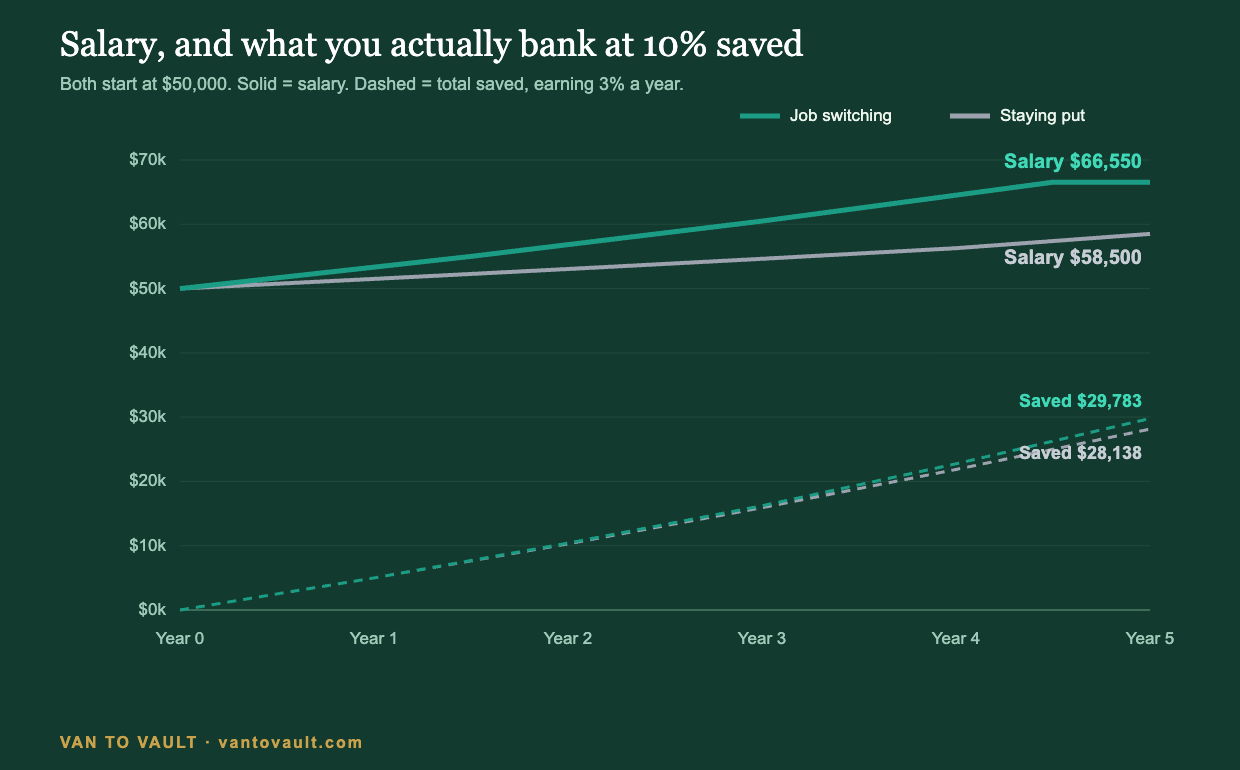
Now put a real number on it. Say each version of you saves 10% of what you earn and parks it somewhere paying 3% a year. Over the five years, the person who stayed put earns about $265,000 and, with interest, banks about $28,100. The person who switched earns about $282,000 and banks about $29,800. Every raise doesn’t just lift your salary, it lifts how much that same 10% habit sets aside.
Why the five-year savings totals end up so close
When you save a flat 10% of income and both versions of you started at the same $50,000, the switcher’s paychecks only pull well ahead in the last year or two, so they barely move the five-year total. In real terms it matters even less: with costs rising about 2% a year and the cash earning 3%, that pile gains only about 1% a year in actual buying power.
The real prize isn’t the five-year cash pile. It’s the salary itself. By year five the switcher earns about $8,000 more every year, and that gap compounds. Five years is just where the two lines start to pull apart.
Why Companies Don’t Compensate Internal Moves
There’s an idea that leaving looks bad, that companies reward loyalty. It’s mostly backwards, and it is out of date: pensions, well-funded 401(k) plans and simple medical coverage were once genuine reasons to stay.
When staying at one employer actually pays
A 401(k) match worth keeping is the clearest case: an employer matching 100% of your contributions up to, say, 8% of pay, on a vesting schedule you have not finished, is real money you forfeit by leaving. An employer covering both your and your spouse’s healthcare premiums is the other. Check both before you move.
Some of those reasons still exist. But benefits in the workforce have become complicated, often un-useful, and rarely as good as a defined benefit pension.
How HR salary bands cap internal raises
Companies have budgets for new hires that don’t apply to current employees. HR has salary bands for positions. If you’re already inside your company’s band for your current role, getting you to the next band usually requires a promotion, and promotions happen on someone else’s timeline, not yours.
When you switch jobs, you are negotiating a new band. You are a market rate entry point, not an internal adjustment.
I’ve been on both sides. As an employee, the bump from an external hire was always bigger than what I could get for the same role by staying. As a manager, I couldn’t fight for my existing team the way I could fight for a new headcount budget. That is how the system works, rather than anything personal.
The “Loyalty” Argument Doesn’t Hold
I’m not rejecting all pushback on this. Stability matters. Your specific situation will also dictate whether or not it is worth considering. And sometimes it can be beneficial to have shown you can “stick with something.” Some employers value commitment.
All true. But commitment doesn’t equal staying at one company for your entire career. Does it even mean doing your job well, finishing what you start, and not job-hopping every six months, just to be rewarded with a 2% bump?
Why an 18-month tenure is not job hopping
Switching every 12-18 months is not flaky. It’s smart career management. Most professional roles take 6-12 months to really hit your stride and contribute meaningfully anyway. By month 18, you’ve learned the systems, built relationships, delivered something. You’re valuable. That’s the moment to leave, while you have the most leverage.
If an employer thinks that’s disloyal, that’s a signal about the employer, not about you. It is also always possible that if they value you as much as a competitor might, they’ll offer you the same or more to keep you (which poses its own risks, but is worth considering). If they don’t, why would you stay?
It Gets Harder the Longer You Wait
There’s a real cost to staying too long in one place: your resume gets stale. Your skills can atrophy, as you get locked into the same systems and same tasks.
After three or four years at the same company, hiring managers start to wonder why you haven’t moved: did you get comfortable, are you afraid of change, have you even tried to leave?
What a 12 to 18 month pattern signals to hiring managers
Switching every 12-18 months, on the other hand, tells a story: you delivered, you learned, you leveled up, you did it again. You’re reliable. You’re ambitious without being reckless.
Also, the longer you stay in a single company, the more your specific skills and context become hard to translate to an external market. Your technical skills are current. But your salary history, your internal titles, your specific tools: they all become less relevant to what the outside world will pay.
How switching jobs compounds salary over time
The compounding comes from the moves themselves.
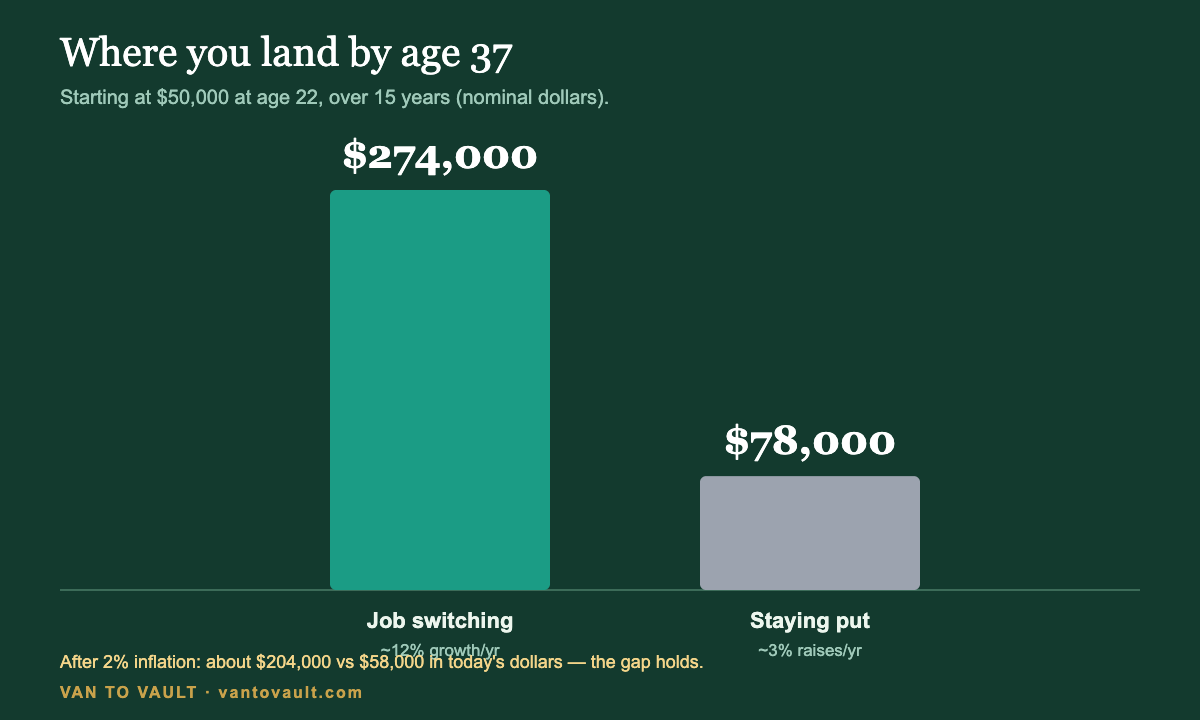
Get a raise of about 12% a year, every year, starting early in your career, by actively moving to jobs that pay more instead of waiting on promotions or annual raises.
Run that forward fifteen years.
| Path from $50,000 at 22 | Salary at 37 | In today’s dollars |
|---|---|---|
| Switching, averaging 12% growth a year | About $274,000 | About $204,000 |
| Staying put on 3% annual raises | About $78,000 | About $58,000 |
That gap is the difference between a real down payment, a funded retirement plan and some investments on one side, and still paying off student loans and still priced out of the housing market on the other. Every dollar you are not making at 25 is five years of lost growth, lost investing, lost compounding.
Example three: turning the raises into a duplex
This is the part that actually changed my life, and it’s the path I took.
In five years the switcher is earning $66,550, about $8,000 a year more than the person who stayed and roughly a third above where they both started.
By year five, the aggressive switcher is earning about $66,550 and has saved about $29,800. That isn’t enough to buy a house outright, and it doesn’t need to be. At 3.5% down, the down payment on a $470,000 duplex is about $16,450. The savings covers the down payment and most of the closing costs.
In my case a county first-time-buyer program helped on my starter home, and the equity from that house became the duplex down payment a few years later.
The duplex isn’t only a place to live.
- The second unit plus an Airbnb basement bring in roughly $20,000 to $30,000 a year.
- A 30-year fixed rate under 4% kept the payment near $2,100 a month before taxes and insurance, and the rental income covered most of it.
- Lenders count most of that rental income, so a $66,550 salary plus the rent qualified comfortably where the stay-put salary would have been a stretch.
- You own a $470,000 asset that pays itself down every month and appreciates while you sleep.
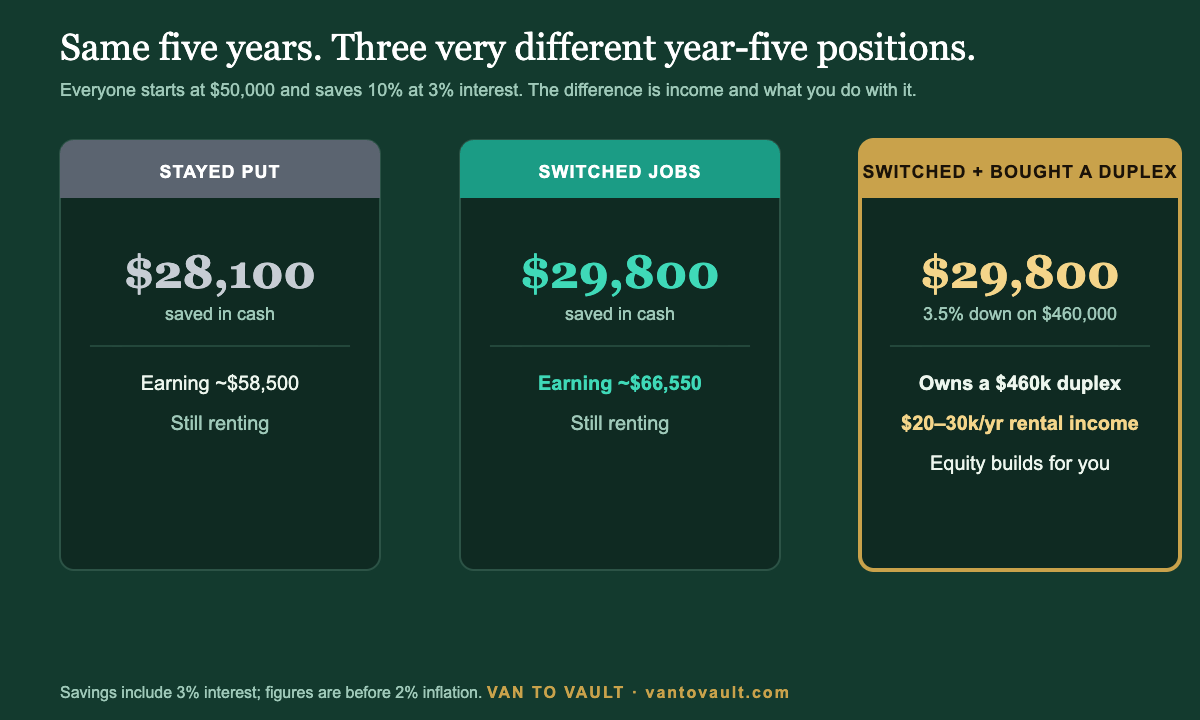
Line up the three people at year five.
| Path | Cash at year five | Where that leaves them |
|---|---|---|
| Stayed put | About $28,100 | Still renting |
| Switched jobs | About $29,800 | In position to buy, with no rental income yet |
| Switched and bought the duplex | Nearly the same cash, now a down payment | Controls a $470,000 income-producing asset paying $20,000 to $30,000 a year and building equity |
| At year five | Cash saved | Salary | Position |
|---|---|---|---|
| Stayed put | About $28,100 | About $58,500 | Still renting |
| Switched jobs | About $29,800 | About $66,550 | Able to buy, no rental income |
| Switched and bought the duplex | Nearly the same cash, put to work as a deposit | About $66,550 | Controls a $470,000 asset paying $20,000 to $30,000 a year |
The salary bump from switching was never really the point. The point is that it got you to a down payment a couple of years sooner, and a couple of years sooner is the whole game when you’re compounding. The same $29,800 can sit in a savings account, or it can be the down payment on an asset many times its size that pays you to own it.
One caveat: I bought when I could lock a 30-year fixed mortgage rate under 4%. Here in 2026, rates are higher, which makes the monthly payment meaningfully larger and the whole move harder to pull off right now. The principle still holds, switch for the higher income, save your 10% or more, and let an income-producing property carry most of the cost; you just have to run the numbers at today’s rates. Throughout, I’ve assumed savings earn 3% a year and inflation runs 2% a year, so a dollar of cash gains only about 1% in real buying power each year. These are illustrative figures to show how the pieces fit together, not a forecast or financial advice. Your market, interest rates, and the programs available to you will be different.
How often to switch jobs for higher pay
Switch when you hit the point of diminishing returns, usually 18 months to two years into a role. Not earlier: you need to deliver something, and you need the experience. Not later, the longer you stay, the staler you get and the less leverage you have to negotiate.
When you start looking, don’t undersell yourself. The outside market will almost always offer more than you think you’re worth. Companies have bigger pools of money for hiring than they do for internal raises.
What to do when your employer counter-offers
Usually a counter-offer is too little, too late. They’re reacting, not leading. And there’s an outside shot you’d be looking over your shoulder if you got a significant raise but continued in the exact same role.
The fact that it took you leaving to get them to budge is itself the data point. They weren’t planning to pay you that much while you stayed.
The loyalty is to yourself: to your growth, your family’s financial security, and your actual market value. You are giving your time in return for compensation, and the company is looking at the arrangement just as simply. You aren’t “family,” and you don’t owe them more than the work you offer. Don’t let opinions from a different era, or peer pressure, keep you from taking leaps and bounds. That is the path of the status quo, not a pathway out.
Before adding a side hustle instead, run the math on what your time is actually worth in gig work.
Get started with the newsletter!
Useful, relevant analysis, tools, tricks, and what you need to know on the journey to financial freedom. From the van years to a duplex, the plain math and none of the hype.
Subscribe and get the free $0-to-First-Property Roadmap to start.
No spam. Unsubscribe in one click.
Want the deeper toolkit? The guides and spreadsheets are in the shop, from $5, and the free tools stay free either way.
Sources
- Federal Reserve Bank of Atlanta, Wage Growth Tracker. The series that reports wage growth separately for job switchers and job stayers, which is the pattern this whole post is built on.
- U.S. Bureau of Labor Statistics, Employee Tenure Summary. How long people actually stay with one employer, useful context for whether moving every eighteen months reads as unusual.
- U.S. Bureau of Labor Statistics, Consumer Price Index. The published inflation measure behind the assumption used above, and the reason a small annual raise can still lose ground.
- Freddie Mac, Primary Mortgage Market Survey. The weekly rate series to check before copying the duplex step, since the rate I locked is not the rate on offer today.
See what one raise compounds into.
The free projection tool. Enter your income now and after a switch, and it shows what the gap becomes over the years you would be saving a down payment.
How much more do you earn by switching jobs instead of staying?
In the example on this page, someone starting at $50,000 who moves every eighteen months for a 10 percent bump is earning $66,550 after five years. That is about $8,000 a year more than the person who stayed and took typical annual raises of 2 to 4 percent.
Why do employers pay more to new hires than to their own staff?
A new employer prices you at what the market costs today. An internal review usually starts from what you are already paid and adds a small percentage on top. That is why a 2 to 4 percent raise can lose ground to the market even when it is presented as a reward.
What can the extra salary actually buy you?
The post follows the raises through to a specific end: the difference is enough to fund the cash needed for a first duplex you live in, which is the point of raising income rather than only cutting expenses.