
Duplexes in Chicago IL 2026: Prices, Rents, Cost to Own
Dated note, 24 September 2026: the Foothold Index table shows Chicago keeping $184 a month against renting. That is the August 2026 edition at a 6.66% model rate. This page re-runs the figures at 6.71% (Freddie Mac PMMS, week of September 3, 2026).
The short version: a two-to-four-unit home in Chicago costs real money to get into, but the rented units carry enough of the payment to beat renting. Entry price is $449,000, the median surviving listing is $550,000, and the rent from the two rented units in the median building covers enough of the payment that you keep $169 a month compared with renting.
How much does a duplex cost in Chicago in 2026?
1353 two-to-four-unit homes were listed in the Chicago metro when this ran. 366 of them passed my checks on a price floor, the FHA loan limit, gross rental yield, neighborhood violent crime, abandoned-property share and the five-year value trend. The seventh check, price per square foot, never ran here, because the listing feed had no square footage. The prices on this page are from those 366 survivors, not the raw feed.
What the two prices mean: entry ($449,000) is the 25th percentile, the price at which a quarter of surviving listings sit below you. Typical ($550,000) is the median. The median deal itself was a 3-unit, 6-bedroom building at $550,000 in ZIP 60641.
What is the average rent in Chicago in 2026?
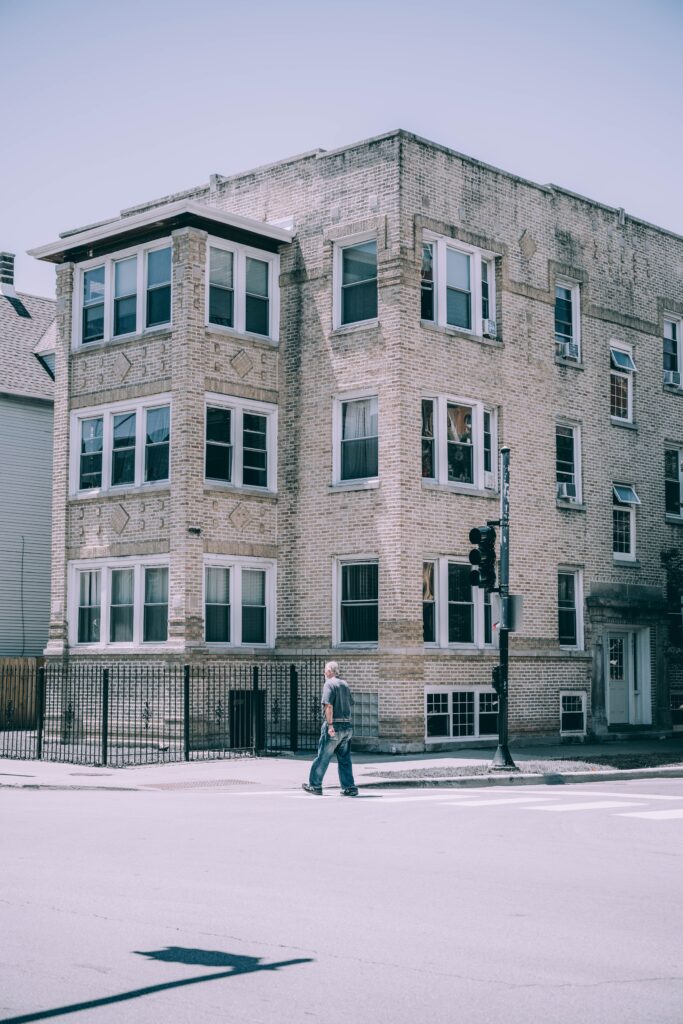
A one-bedroom in Chicago rents for about $2,012 a month, the average of Zumper’s and Apartment List’s asking rents for mid-2026. The model scales that figure by ZIP with HUD’s FY2026 Small Area Fair Market Rents, so a building in a cheaper ZIP is measured against a cheaper rent. A two-bedroom is about $1,720 on HUD’s FY2026 small-area fair market rents, the median across 49 ZIPs, and $2,550 on Zumper’s asking-rent data for May 2026.
Why it matters twice: that rent is what you would pay to keep renting, and it is also roughly what the other unit pays you. The median surviving deal is a three-unit building, so two units are rented, and together they collect $3,893 a month. I count that rent only after a maintenance and vacancy allowance. It is not treated as free money.
What you pay each month living in one unit and renting out the rest
The full payment on the median deal, with an FHA loan at 3.5% down and a 6.71% 30-year fixed rate, is $4,999 a month including mortgage insurance, property tax and insurance. The two rented units bring in $3,893 between them, about $1,947 each. After the allowance, your share of the month is about $1,842, against $2,012 to rent a one-bedroom nearby.
How the mortgage rate changes what you keep in Chicago
| Mortgage rate | Median deal, per month, versus renting |
|---|---|
| 5.00% | keeps $710 |
| 5.50% | keeps $537 |
| 6.00% | keeps $367 |
| 6.50% | keeps $231 |
| 6.71% (model rate) | keeps $169 |
| 7.00% | keeps $44 |
| 7.50% | $133 behind renting |
What this means for you: at 5.00% the median deal keeps $710 a month; at 7.50% it is $133 a month behind renting. Watch the sign: the deal flips between those two rates, so the week you lock decides whether owning or renting wins here. Every figure is the same 366-listing screen re-run at each rate, prices and rents held.
How much income do you need to buy a duplex in Chicago?
- Full payment$4,999On the typical building at 6.71%
- Income, front-end guideline$193,514Payment at 31% of gross income
- Income, back-end guideline$139,51043%, with no other debt
- Median household income$90,770What the median household here earns
On the typical $550,000 building the full payment at 6.71% is about $4,999 a month. FHA’s front-end guideline (payment at 31% of gross income) puts that at $193,514 a year. The back-end guideline (43%, with no other debt) puts it at $139,510. Real approvals land between the two.
The part most buyers miss: an FHA lender can count 75% of the rented units’ rent toward your income when it qualifies you. The median household here earns $90,770.
The assistance test: HUD puts the Chicago area median income at $121,500 for a four-person household (FY2026). Most down payment programs cap eligibility at 80% of that, which HUD publishes as $97,200 for four people and $68,050 for one. The $193,514 front-end figure above sits $96,314 over that four-person limit. Household size and each program’s own cap decide it.
Down payment and assistance for a Chicago duplex
Renting the other unit to a Section 8 voucher tenant in Chicago
The short version: with a Housing Choice Voucher, the tenant pays a share of the rent set from their income and the housing authority pays you the rest, up to a cap called the payment standard. In Chicago the main voucher agency is the Chicago Housing Authority (CHA). I did not find a current two-bedroom payment standard on the pages I read, so ask the housing authority for the figure that applies to the building.
Chicago’s metro is on HUD’s mandatory Small Area Fair Market Rent list, but CHA, a Moving to Work agency that HUD lets opt out, says it does not use them and sets one citywide standard within 90% to 110% of HUD’s Fair Market Rent. For scale, HUD’s FY2027 metro-wide two-bedroom Fair Market Rent for the Chicago-Joliet-Naperville, IL HUD Metro FMR Area, in effect from October 1, 2026, is $2,011 (FY2026: $1,781), and a basic-range payment standard runs from 90% to 110% of the published figure that applies.
As of September 2026, CHA can also approve, case by case, a payment standard of up to 150% of HUD’s Fair Market Rent for units in its Mobility Areas: community areas with 20% or less poverty and below-median violent crime, or moderate poverty and crime plus other positive indicators. Rent reasonableness still applies.
The catch: the payment standard is a ceiling, not an offer.
HUD’s rule is that “the PHA may not approve a lease until the PHA determines that the initial rent to owner is a reasonable rent”, judged against rents for similar unassisted units.
The housing authority’s monthly payment is the lower of the payment standard or the gross rent, minus the tenant’s share, and when the rent is above the payment standard, a family moving in cannot take on a share above “40 percent of the family’s adjusted monthly income”.
A rent well above what similar units nearby get can fail even when it sits under the payment standard.
The inspection: before the lease starts, HUD’s rule requires that “The unit has been inspected by the PHA and passes HQS”; HQS are HUD’s Housing Quality Standards. HUD is moving voucher inspections to its newer NSPIRE standard, but under Notice PIH 2026-18 housing authorities “may continue using HQS as previously defined or other HUD-approved inspection methods as their inspection standards until February 1, 2027”.
What Illinois law says about voucher tenants: Illinois law has covered source of income in housing since January 1, 2023: it is a civil rights violation to refuse to rent “because of” source of income (775 ILCS 5/3-102), which the Human Rights Act defines as “the lawful manner by which an individual supports himself or herself and his or her dependents”, and the state’s Department of Human Rights lists Housing Choice Vouchers among the protected sources.
The house-hacking detail is the owner-occupied exemption: Section 3-106 does not prohibit “Rental of a housing accommodation in a building which contains housing accommodations for not more than 4 families living independently of each other, if the owner resides in one of the housing accommodations”, so state law does not reach a two-to-four-unit home you live in, though its ban on advertising a preference still applies.
Locally: Chicago’s Fair Housing Ordinance covers Section 8 Housing Choice Vouchers, and its exemptions section (5-8-050) lists no owner-occupied exemption, so as I read it the city rule reaches a building you live in even where the state rule does not.
Cook County’s ordinance also covers vouchers. Source of income is not a federal protected class: the Fair Housing Act’s rental rule lists “because of race, color, religion, sex, familial status, or national origin”. This summarizes what the laws say; it is not legal advice.
One more 2026 fact: in December 2025 HUD recommended that housing authorities “Stop issuing new vouchers (except HUD-VASH and new FYI vouchers)” to keep 2026 costs inside their funding. Fewer new voucher holders may be searching while that lasts, so ask the housing authority whether it is issuing.
| Chicago voucher basics | As read September 28, 2026 |
|---|---|
| Main voucher agency | Chicago Housing Authority (CHA) |
| Two-bedroom payment standard | Not published as a table; one citywide standard within 90% to 110% of FMR, and up to 150% of FMR (about $3,017 at the FY2027 two-bedroom FMR, in effect from October 1, 2026) in CHA Mobility Areas; ask CHA |
| Payment standards set by | CHA, one citywide schedule (Moving to Work agency; CHA says it does not use Small Area FMRs) |
| HUD FY2027 two-bedroom Fair Market Rent, from October 1, 2026 (Chicago-Joliet-Naperville, IL HUD Metro FMR Area) | $2,011; FY2026: $1,781 |
| Illinois source-of-income law | Yes (2023); owner-occupied buildings of up to 4 units exempt |
| Local rule | Chicago’s Fair Housing Ordinance covers Section 8 Housing Choice Vouchers, and its exemptions section (5-8-050) lists no owner-occupied exemption, so as I read it the city rule reaches a building you live in even where the state rule does not; Cook County’s ordinance also covers vouchers |
FHA loan limits in Chicago (2026)
FHA, the Federal Housing Administration, is the loan program that lets an owner-occupant buy a two-to-four-unit building with 3.5% down. It caps how large a loan it will insure, county by county. Cook County, IL sits at the national floor for 2026, so the standard limits apply. The cap rises with the number of units, which matters for house hacking: a duplex gets a higher limit than a single-family house.
| Property size | 2026 FHA limit, Cook County |
|---|---|
| 1 unit | $541,287 |
| 2 units (duplex) | $693,050 |
| 3 units | $837,700 |
| 4 units | $1,041,125 |
The cap is not the binding check here. The typical entry price in Chicago is $449,000, about 65% of the two-unit limit, and 3.5% down on $449,000 is about $15,715 before closing costs. Every listing in my screen was already checked against the county FHA limit, so nothing that survived is limit-constrained.
Source: HUD Mortgagee Letter 2025-23, limits effective for FHA case numbers assigned on or after January 1, 2026. Re-read from hud.gov on September 2, 2026.
What local reporting says about Chicago duplex prices
The model is a screen, not a local expert. Here is where independent reporting agrees with it, and where it pushes back.
Where outside sources agree
- BiggerPockets case study: $429,900 North Austin FHA 2-flat cash-flowing ~$450/mo – our $449k entry + thin-positive keep, in the wild.
- Cook County RTLO exempts owner-occupied buildings of 6 or fewer units – the house-hack case dodges the ordinance’s teeth.
- Our spot-check listing (6244 S Seeley, $390,000) verified exact.
Where they do not, and why it matters
- FHA’s TOTAL scorecard routinely accepts back-end DTI of 47-50%+ with compensating factors; our 48.5% debt-to-income ceiling is more conservative than practice, and that is deliberate.
- Cook County’s 2024 reassessment: median city bill +16.7%, West/South side neighbourhoods +99-133% – concentrated EXACTLY where the affordable two-flat stock survives. Our tax line uses a metro rate; the within-metro skew means our cheap-tail listings will see worse than metro-average tax growth.
- Two-flat stock is shrinking (~21,000 2-4 unit rentals lost 2011-2015 to deconversion) and the DePaul institute calls the surviving stock ‘in distress’ – with no sqft data, none of it condition-screened.
What this page does not tell you
- Flood insurance is not modeled anywhere in this analysis. Budget for it separately.
- Condition is screened statistically, not inspected. A cheap building can still be a money pit.
- The rent figure is a market benchmark, not a signed lease. Verify achievable rent on the specific unit.
- An FHA owner-occupant loan requires you to live in one of the units for at least a year.
- Accessory dwelling unit rules for Chicago are not sourced on this page yet.
Run your own numbers for Chicago
Starts on the median surviving deal in this report. Move any slider to see what changes.
Cash to close is separate: down, before closing costs. Taxes and insurance scale with price at this metro’s modeled rate. The rent allowance is , the figure used for Chicago throughout this report.
Next step
These are Chicago averages. The specific building you are looking at will not match them — its price, its rent, its payment and the assistance you qualify for are all particular to it.
The First-Property Bundle is how you run that building: six calculators including the house-hack analyzer, the playbook, and a 15-minute workflow for finding the down payment assistance in your own county.
This page stays free either way.
Keep comparing: first-time buyer programs in Illinois, and the duplex numbers for Indianapolis and Minneapolis.
Where these numbers come from
- Real 2-flat house-hack case studies, BiggerPockets, 2025
- FHA DTI flexibility to 50%+, Lower.com, 2026
- Median tax bill +16.7%, West Side +133%, WBEZ, 2025
- Two-flat stock in distress, DePaul IHS, 2024
- RTLO owner-occupant exemption, Chicago Assoc. of REALTORS, 2024
- Listing prices and counts: active two-to-four-unit listings (Realtor.com, Movoto), screened for price floor, FHA county limit, gross yield, neighborhood violent crime, abandoned-property share and home-value trend (price per square foot was not checked in Chicago; the feed had no square footage).
- Rents: the one-bedroom figure is the average of Zumper and Apartment List metro asking rents (May to July 2026; RentCafe stands in for Zumper in Cleveland and Scranton, and is Buffalo's only series, August 31, 2026); the model scales it per ZIP by HUD FY2026 Small Area Fair Market Rents relative to the metro FMR. The two-bedroom figure is the HUD FY2026 SAFMR median across the ZIPs where surviving listings sit, with Zumper's two-bedroom asking rent as a second reading. Six metros carry a single one-bedroom series (Bakersfield, Buffalo, Rochester, Scranton, Syracuse, Youngstown).
- Local economy: unemployment is the BLS metro rate where one is published and the state rate otherwise; rental vacancy is the Census Housing Vacancy Survey state rate for every metro; median household income is ACS 2024 one-year (B19013); population is the Census Vintage 2025 metro-area estimate.
- Neighborhood safety screen: violent crime by ZIP, CrimeGrade.org, anchored to FBI city-level rates (Table 8, 2019).
- Mortgage rate: 30-year fixed, Freddie Mac Primary Mortgage Market Survey: 6.71% is the rate used throughout this analysis. The rate chart re-runs the same screen at each rate.
- Loan terms and mortgage insurance: FHA 3.5% minimum down payment and MIP schedule, HUD Handbook 4000.1. Income guidelines: FHA 31% / 43% qualifying ratios, same handbook. Area median income and the 80% limit: HUD FY2026 Income Limits (Section 8), huduser.gov.
- Property taxes: county effective property-tax rates. Insurance: state average premiums, scaled to price.
- Down payment assistance: state and local program terms, checked for two-to-four-unit eligibility.
- All of it, as one file: the open data page (CC BY 4.0).
- The Chicago Housing Authority (CHA), landlord page; CHA, HCV Administrative Plan (effective October 1, 2025), chapter 16; FY2026 MTW Annual Plan (approved by HUD January 27, 2026), activity 2010-02; Mobility Area map; read September 28, 2026.
- HUD, Designated Small Area Fair Market Rent (SAFMR) Areas (last updated August 2024): "The following 65 metro areas are designated as mandatory SAFMR areas by HUD." HUD, Notice PIH 2024-34 (September 30, 2024), on Moving to Work agencies and Small Area FMRs.
- Code of Federal Regulations, 24 CFR 982.503 (payment standard basic range), 982.505 (the monthly payment), 982.507 (reasonable rent), 982.508 (the 40% limit at move-in) and 982.305 (inspection before the lease); read September 28, 2026.
- HUD, Notice PIH 2026-18 (July 15, 2026), NSPIRE administrative procedures for voucher programs.
- Source-of-income law: Illinois Human Rights Act, 775 ILCS 5 (Justia copy of 2025 Illinois Compiled Statutes); 775 ILCS 5/3-106; Illinois Department of Human Rights, source of income FAQ; local ordinance; 42 U.S.C. §3604(a); read September 28, 2026.
- NAHRO, HUD Recommends PHAs Cease Issuing New Vouchers (December 23, 2025).
- HUD, FY2026 Fair Market Rents (revised), Chicago-Joliet-Naperville, IL HUD Metro FMR Area (METRO16980M16980); read September 28, 2026. FY2027 figures: HUD, FY2027 Fair Market Rents, Chicago-Joliet-Naperville, IL HUD Metro FMR Area (METRO16980M16980), effective October 1, 2026; read September 29, 2026.
Figures reflect the Foothold model run at the 6.71% model rate (Freddie Mac PMMS, week of September 3, 2026) on listings from June to August 2026, and are estimates for comparison, not an appraisal or a loan quote. Verify the numbers on any specific building before making an offer.
Questions people ask about buying a duplex in Chicago
How much does a duplex cost in Chicago?
A duplex in Chicago costs $449,000 at the entry level (25th percentile) and $550,000 at the median, measured across the two-to-four-unit listings that passed the 2026 Foothold screen. Both are list prices.
What is the average rent in Chicago in 2026?
Average rent in Chicago is about $2,012 a month for a one-bedroom, the average of Zumper and Apartment List asking rents for mid-2026, and about $1,720 for a two-bedroom on HUD FY2026 small-area fair market rents, the median across the ZIPs in this report.
Is it cheaper to own a duplex than to rent in Chicago?
Owning the median two-to-four-unit and renting the other two units costs about $1,842 a month all-in, against about $2,012 to rent comparable space, so owning keeps about $169 a month while building equity.
How much do you need to put down on a duplex in Chicago?
The minimum down payment is 3.5% of the purchase price under an FHA loan, about $15,715 on a $449,000 entry building, plus closing costs. IHDAccess Repayable (Illinois Housing Development Authority) adds 10% of the price, up to $10,000, for eligible owner-occupant buyers on a one- or two-unit home; a three- or four-unit building does not qualify.[S2]
How much income do you need to buy a duplex in Chicago?
The income needed for the typical $550,000 duplex is about $193,514 a year on FHA's 31% front-end guideline, or $139,510 on the 43% back-end guideline with no other debt, before a lender counts 75% of the rented units' rent.
Why does Chicago rank #9 on the Foothold Index?
The Foothold Index rank is defined by three weighted scores: how affordable it is to get in, what the deal does for your monthly cash, and how durable the local economy looks over a decade. Chicago ranks #9 of 11 on that combination, out of 83 metros screened.
Next step
This page is free and stays free. The First-Property Bundle is the part you run yourself: the five-stage playbook from van to duplex with a worked example, a six-calculator workbook for testing any listing you find, and a 15-minute workflow for finding the down payment assistance in your own county. Pay what you want, $5 minimum.
Get started with the newsletter!
Useful, relevant analysis, tools, tricks, and what you need to know on the journey to financial freedom. From the van years to a duplex, the plain math and none of the hype.
Subscribe and get the free $0-to-First-Property Roadmap to start.
No spam. Unsubscribe in one click.
Want the deeper toolkit? The guides and spreadsheets are in the shop, from $5, and the free tools stay free either way.
Sources
- [S1] Illinois Housing Development Authority (IHDA), ALL-PROGRAMS MATRIX - MARCH 2026 (PDF created 2026-02-26), read 24 September 2026: “ALL-PROGRAMS MATRIX - MARCH 2026” www.ihdamortgage.org.
- [S2] Illinois Housing Development Authority (IHDA), ALL-PROGRAMS MATRIX - MARCH 2026 (PDF created 2026-02-26), read 24 September 2026: “Single Family owner-occupied primary residence (1 - 2 units only, condo, townhouse, community land trust) on less than 5 acres, No Manufactured” www.ihdamortgage.org.
- [S3] Neighborhood Housing Services of Chicago, HomeGrown Purchase Assistance Program, read 2 October 2026. nhschicago.org.
If you use Google, you can pick Van to Vault as a preferred source. Google can then mark this site as preferred in your Top Stories and, where it shows them, in AI Mode and AI Overviews.
Your numbers
What would a duplex in Chicago cost you each month?
The calculator opens at this page's entry price, $449,000, with $2,012 rent from the other unit and a 6.71% rate. Put in your own price, rent and down payment to see what moves.
Open the calculator with these numbers Check a specific building in Deal Math