
“Tiny home” covers three different things in law. Only a code-built house on a foundation is generally a permanent home a mortgage can reach; a house on wheels is a legal full-time home only where a local ordinance says so[S1][S2].
Published October 2026. Sources checked October 6, 2026.
| Figure | What it is | Source |
|---|---|---|
| 400 | square feet or less, not counting lofts: the code’s tiny-house size, where adopted | [S4] |
| $30,000 to $60,000 | to build, as HomeAdvisor reports; most spend around $45,000 | [S11] |
| $60,000 to $80,000 | on wheels, as HomeAdvisor reports | [S11] |
| $8,016 and $5,500 | typical septic install and average well, as HomeAdvisor reports | [S12][S13] |
| 11.86% | average 24-month bank personal loan rate, Q2 2026 | [S14] |
| $2,115.37 | a month to borrow $45,000 that way (modeled) | [S14] |
| 3 to 5 years | renewable permit for a house on wheels, City of San Luis Obispo | [S9] |
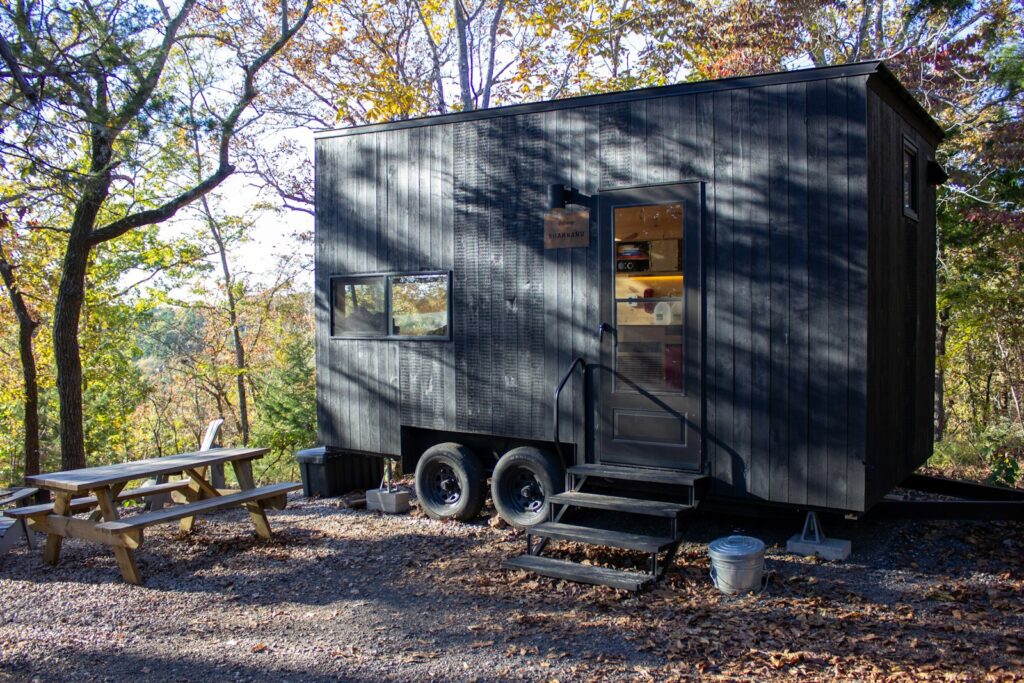
Three things called a tiny home
The law treats a code-built house, a house on wheels and a stay in an RV park as three different things.
| Item | Permanent dwelling | Movable unit | Temporary use |
|---|---|---|---|
| What it is | Small house on a foundation, built to code | Tiny house on wheels (THOW): an RV or park model RV | An RV or park model in an RV park or campground |
| Legal identity | Real property, a dwelling | Vehicle, personal property | Recreational use |
| Full-time home? | Yes, if it meets the adopted code and zoning | Only where a local ordinance allows it[S2] | Recreational by default; stay limits are local |
| Financing | Cash; a mortgage is possible | Cash, personal, RV or chattel loan (on the unit alone) | As a movable unit |
A permanent dwelling: the code-built tiny house
A tiny house built to the residential code’s appendix is a dwelling, but only where a state or local government adopts the appendix[S5].
- The appendix: Q in the 2018 International Residential Code, AQ in 2021[S3][S4]; 400 square feet or less, with relaxed ceiling-height and loft rules[S4].
- Where: statewide in Minnesota[S6]; local option in California and Georgia[S7][S5].
- Skip online state lists: the one we checked is from 2019 and conflicts with California’s housing agency.
- Code is not zoning: zoning can still set a minimum dwelling size; ask about both.
A movable unit: the tiny house on wheels
If your tiny house on wheels is certified as an RV or park model, its maker says it is not a primary residence[S1].
- Federal rule: RVs and park models are exempt from the HUD code only if designed for recreation; park models must say “designed only for recreational use, and not for use as a primary residence or for permanent occupancy”[S1].
- California: generally only in mobilehome or special occupancy parks, unless a local ordinance allows otherwise[S2].
- Temporary use: RV parks and campgrounds are the default legal setting; stay limits are local[S2].
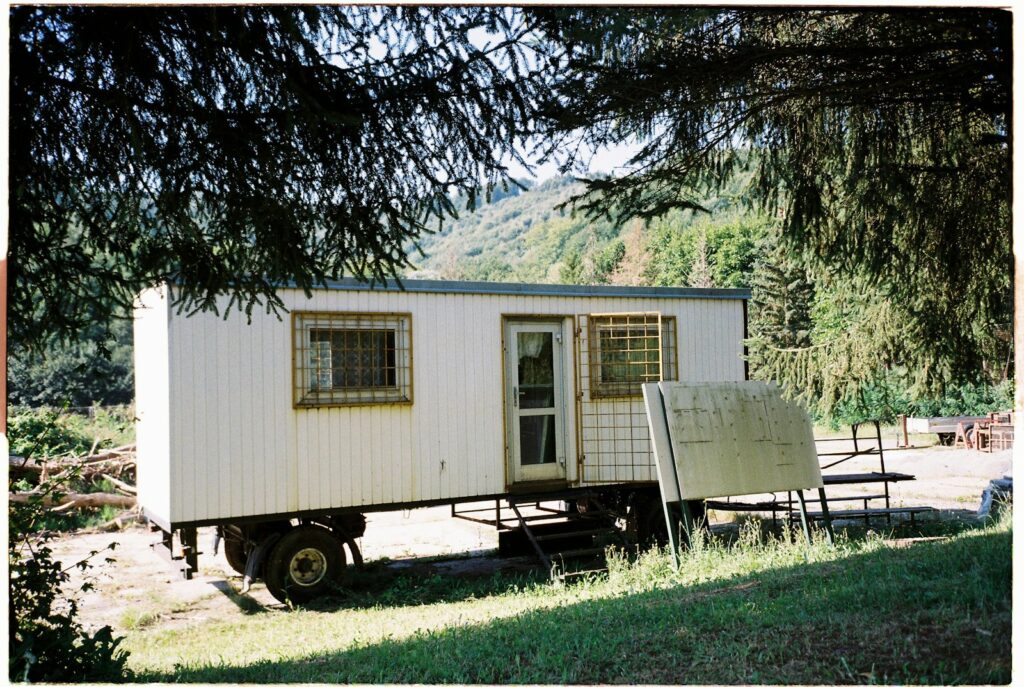
Where local rules allow it
| Place | Rule for a house on wheels | Source |
|---|---|---|
| Fresno | A backyard cottage (a type of ADU) if the owner lives on site; DMV registration, ANSI standards for RVs, a concrete pad, sewer and water | [S8] |
| City of San Luis Obispo | One per owner-occupied property, up to 400 square feet excluding lofts; renewable 3 to 5 year permits | [S9] |
| County of San Luis Obispo | Not outside approved campgrounds and RV parks in unincorporated areas; homes on a permanent foundation are permitted | [S10] |
Is this path for you?
It suits a mostly-cash buyer with land where the rules allow the unit.
It can fit if
- Your land’s rules expressly allow the unit as a dwelling.
- You can pay mostly in cash.
- 400 square feet or less works for your household[S4].
It does not fit if
- You need a mortgage for a house on wheels.
- No local ordinance allows one.
- You count on resale value: we found no public data on it.
The complete cost
The home is the sourced part; land, permits and hookups have no national figure, so get local quotes.
| Item | On a foundation, own land | On wheels, own land where allowed | On wheels, RV park |
|---|---|---|---|
| Upfront cash | Home, land, utilities, foundation, permits | Home, land, utilities, pad, permits | Home; park deposit |
| Monthly cost | Any loan, property tax, insurance, utilities | Loan, property tax, insurance, utilities | Loan, park rent, insurance |
| Security | Highest, if permit and code are met | Depends on the local permit; some expire[S9] | Park rules and local stay limits |
| Verify locally | Adopted code, minimum size | Ordinance, owner occupancy, hookups | Stay limits; use as an address |
| Exit | Sells as real estate | Moved or sold; no resale data | As on wheels |
Financing
Most mortgages do not fit a tiny house on wheels: it is personal property, and its maker certifies it is not a primary residence[S1].
| Route | What applies | Source |
|---|---|---|
| Cash, or a personal, RV or chattel loan | The usual routes on wheels; banks’ 24-month personal loan rate was 11.86% in Q2 2026 | [S14] |
| Chattel loans | Generally higher rates and fewer protections than mortgages, the CFPB found | [S15] |
| Manufactured-home mortgage | At least 400 square feet and 12 feet wide, wheels and axles removed (Fannie Mae); USDA, same 400 floor | [S16][S17] |
| Code-built house | May qualify as real property; for modular homes, similar sales make the appraisal more reliable | [S18] |
What the 2026 law changes
Very little: in our reading of the CRS summary, the ROAD to Housing Act creates no new tiny-home category[S19].
- Already law: a maker could certify a home under the size thresholds, such as one under 320 square feet[S20]. See our ROAD to Housing Act guide.
Traps
Check these before you buy.
- Illegal occupancy: full-time living in a recreational unit where no ordinance allows it[S1][S2].
- Owner-occupancy permits: Fresno and San Luis Obispo require the owner on site; San Luis Obispo permits expire[S8][S9].
- Insurance: RV cover may be needed, insurers may require RVIA certification, and undocumented or uninspected DIY builds are hard to insure, Insurance.com reports[S21].
- Resale and short loans: plan for lost value; a 24-month loan means a high payment[S14].
Check it where you live
Six local answers decide whether a tiny home is legal and financeable where you want it.
| What to check | Who to ask |
|---|---|
| Has your area adopted the tiny-house appendix? | The building department |
| Is a house on wheels allowed as a dwelling, and what minimum size? | The planning or zoning office |
| Septic (a soil test) and well permits | The county health department |
| Power, water and sewer connection costs | Your utilities |
| A written quote before you buy or build | An insurance agent |
| Mortgage, or only a personal or RV loan? | A lender |
Modeled example: a fill-in budget
Before land, the sourced lines come to $58,516 on a foundation and $73,516 to $93,516 on wheels.
| Line | On a foundation, raw land | On wheels, raw land where allowed |
|---|---|---|
| Home | $45,000 (typical) | $60,000 to $80,000 |
| Septic, if no sewer | $8,016 (typical) | $8,016 (typical) |
| Well, if no public water | $5,500 (average) | $5,500 (average) |
| Sourced subtotal | $58,516 | $73,516 to $93,516 |
| Land, foundation or pad, utilities, permits, survey, driveway, insurance and tax | Your quote | Your quote |
- Foundation: $45,000 + $8,016 + $5,500 = $58,516.
- Wheels: $60,000 or $80,000, plus $13,516, gives $73,516 to $93,516.
- Financing, for illustration: $45,000 for 24 months at 11.86%, the Federal Reserve’s Q2 2026 rate[S14]; the term is an assumption.
- Payment = P × r ÷ (1 − (1 + r)−n), r = 0.1186 ÷ 12 = 0.0098833, n = 24: $45,000 × 0.0098833 ÷ (1 − 0.78975) = $2,115.37 a month.
- Total repaid: $50,769, of which $5,769 is interest.
Tiny home: sourced costs before land, and the cost of a short loan
- Against renting: divide your upfront cost by your monthly rent, then add the monthly lines and any loan payment.
A documented case
We have no documented tiny-home case yet.
I lived in a van for about thirteen months, from 2016 to February 2017; “I did not choose it as a lifestyle,” and “It didn’t really work out”[S22]. More in Should I get a tiny home? Built or lived in one? Write to hello@vantovault.com; we publish cases only with consent.
Run your numbers in the housing path check, tiny-home mode: land, setup and the home against your current rent. For a longer view, compare with the rent vs buy calculator.
Common questions
Is it legal to live full time in a tiny house on wheels?
Only where a local ordinance allows it[S8][S9][S10]. See where local rules allow it.
Can I get a mortgage on a tiny home?
Possibly, for a code-built house on a foundation; not for one on wheels[S1][S16]. See financing.
What size counts as a tiny house?
400 square feet or less, not counting lofts, where the code appendix is adopted[S4]. See the code-built tiny house.
Get started with the newsletter!
Useful, relevant analysis, tools, tricks, and what you need to know on the journey to financial freedom. From the van years to a duplex, the plain math and none of the hype.
Subscribe and get the free $0-to-First-Property Roadmap to start.
No spam. Unsubscribe in one click.
Want the deeper toolkit? The guides and spreadsheets are in the shop, from $5, and the free tools stay free either way.
Sources
- 24 CFR 3282.15, Exemption for recreational vehicles, Electronic Code of Federal Regulations, current text (accessed October 6, 2026). Supports the recreational-use condition for the RV exemption and the required park model notice.
- Information Bulletin 2016-01 (Revised), California Department of Housing and Community Development, May 9, 2016 (accessed October 6, 2026). Supports that RVs and park trailers generally may be occupied only in parks unless a local ordinance allows otherwise.
- Article on Appendix Q, Tiny Houses, by Paul Lagasse, International Code Council, February 24, 2018 (accessed October 6, 2026). Supports that the tiny-house appendix became part of the 2018 IRC.
- Seattle Residential Code 2021, Appendix AQ, Tiny Houses, City of Seattle, 2021 code with state and city amendments (accessed October 6, 2026). Supports the 400 square-foot definition excluding lofts and the ceiling and loft rules.
- GA International Residential Code 2020 Amendments, Appendix Q: Tiny Houses, Georgia Department of Community Affairs, effective January 1, 2020 (accessed October 6, 2026). Supports that the appendix is not mandatory unless referenced in a local ordinance.
- Minnesota Rules, chapter 1309, Minnesota Office of the Revisor of Statutes, effective March 31, 2020 (accessed October 6, 2026). Supports statewide adoption of Appendix Q.
- Information Bulletin 2020-06, California Department of Housing and Community Development, May 12, 2020 (accessed October 6, 2026). Supports that Appendix Q is voluntary in California and mandatory only where locally adopted.
- Tiny Homes handout with submittal requirements, City of Fresno, undated (accessed October 6, 2026). Supports Fresno’s rules for a tiny house on wheels as a backyard cottage.
- Tiny Home on Wheels, City of San Luis Obispo, undated (accessed October 6, 2026). Supports the city’s size, owner-occupancy and 3 to 5 year permit rules.
- Movable Tiny Houses, County of San Luis Obispo, Planning and Building, undated (accessed October 6, 2026). Supports the county’s ban on movable tiny houses outside campgrounds and RV parks.
- Cost to build a tiny house, HomeAdvisor, updated June 20, 2026 (accessed October 6, 2026). Supports reported build costs, including on wheels.
- Cost to install a septic tank, HomeAdvisor, updated June 20, 2026 (accessed October 6, 2026). Supports reported septic costs, including aerobic systems.
- Cost to drill a well, HomeAdvisor, updated June 19, 2026 (accessed October 6, 2026). Supports the reported average well cost.
- Consumer Credit, G.19, Board of Governors of the Federal Reserve System, released September 8, 2026 (accessed October 6, 2026). Supports the 11.86% 24-month personal loan rate for Q2 2026.
- Manufactured housing loan borrowers face higher interest rates, risks, and barriers to credit, Consumer Financial Protection Bureau, May 27, 2021 (accessed October 6, 2026). Supports that chattel loans generally carry higher rates and fewer protections.
- Selling Guide B2-3-02, Factory-Built Housing, Fannie Mae, February 4, 2026 (accessed October 6, 2026). Supports the 400 square-foot, 12-foot width and real-property rules for manufactured homes.
- 7 CFR 3555.208, Legal Information Institute, Cornell Law School, current text (accessed October 6, 2026). Supports USDA’s 400 square-foot floor for manufactured units.
- Selling Guide B4-1.4-02, Factory-Built Housing: Modular, Prefabricated, Panelized, or Sectional Housing, Fannie Mae, October 6, 2021 (accessed October 6, 2026). Supports that such homes must meet local building codes and that comparable sales support the appraisal.
- CRS Report R49354, Congressional Research Service, September 17, 2026 (accessed October 6, 2026). Supports its summary of the ROAD to Housing Act, which lists no tiny-home provision.
- 42 U.S.C. 5402, Office of the Law Revision Counsel, current through Public Law 119-101 (accessed October 6, 2026). Supports the existing voluntary certification path for homes below the size threshold.
- Tiny home insurance, Insurance.com, undated (accessed October 6, 2026). Supports its report on RV policies, RVIA certification and insuring DIY builds.
- About, VanToVault, undated (accessed October 6, 2026). Supports the founder’s thirteen months living in a van.