

You probably need less cash than the 20% myth says, but more than the down payment alone. The savings target is four buckets: the down payment, closing costs, a reserve cushion, and a repair float. On a $200,000 house with an FHA loan, that lands near $20,000 all-in, not $40,000, and down payment assistance can shrink it further. The tables below show the math. Figures checked August 2026.
The four buckets, at a glance
Four buckets hold your cash: the down payment, closing costs at 2% to 5%, lender reserves of up to six months, and a repair float.
| Bucket | Typical size | What it covers |
|---|---|---|
| Down payment | 0% to 5%+ of the price, by loan type | Your equity stake at closing |
| Closing costs | 2% to 5% of the price | Lender, title, appraisal, first-year insurance, escrow deposits |
| Reserves | 0 to 6 months of the full payment | What some lenders require left over after closing |
| Repair and move-in float | Your call; I suggest a few thousand | The first 90 days of surprises |
Most articles stop at bucket one. The people who get hurt are the ones who drained everything into the down payment and then met their first furnace repair. Here is each bucket in detail.
Bucket 1: the down payment (and the 20% myth)
Twenty percent down only avoids mortgage insurance on a conventional loan. Conventional allows 3% down for first-time buyers, FHA 3.5% with a credit score of 580 or higher, and VA and USDA go to zero for eligible buyers.
Where the 20% myth comes from
Putting 20% down is the threshold for skipping mortgage insurance on a conventional loan. That is all it is: a way to avoid a monthly fee, not a requirement to buy. Every major loan program admits buyers with far less down, and most first-time buyers use one of them.
| Loan type | Minimum down | Fine print |
|---|---|---|
| Conventional, single-family | 3% | At least one first-time buyer on the loan, conforming price |
| Conventional, 2-4 units (house hacking) | 5% | You live in one unit; conforming price |
| FHA | 3.5% | Credit 580+; insurance stays for the life of the loan at this down payment |
| VA and USDA | 0% | Military service for VA; for USDA, an eligible rural area, household income no higher than 115% of the area median, and no rental unit on the property[S1] |
If you are choosing between the two big programs, I wrote the full head-to-head in FHA vs. conventional for house hacking, including what each one costs you monthly for the privilege of the small down payment.
Bucket 2: closing costs, due in cash at the table
Closing costs run 2% to 5% of the purchase price, due in cash at the closing table, so $6,000 to $15,000 on a $300,000 house.
Plan on 2% to 5% of the purchase price, per Freddie Mac. On a $300,000 house that is $6,000 to $15,000, due in cash at the closing table. The big line items: the lender’s origination fee (0.5% to 1% of the loan), the appraisal, the inspection, title insurance, your first year of homeowners insurance, and the opening deposit for the escrow account that pays your taxes and insurance going forward.
Two ways to shrink the closing-cost bucket
Two ways to shrink this bucket. First, seller credits: in a slow market you can negotiate the seller covering part of your closing costs as a term of the offer. Second, many of the same first-time buyer programs that help with down payments also cover closing costs.
Bucket 3: reserves, what has to be left over
Reserves are money left in the bank after closing, measured in months of your full payment. The lender sets the number; I keep two months.
Some loans require you to show money still in the bank after closing, measured in months of your full housing payment. The requirement depends on the loan program, your credit profile, and the property; buying 2-4 units or carrying a thin file means more. Your lender will tell you the exact number early, so ask at preapproval.
What the lender requires versus what keeps you safe
Separate from what the lender requires is what keeps you safe. My own rule: two months of the full payment, untouched, before I would close on anything. A house does not care that you just spent everything you had.
Bucket 4: the float for the first 90 days
A few thousand dollars set aside for the first 90 days covers the repairs, tools, locks and blinds that never appear on a loan estimate.
Every new house bills you early. Mine did: repairs I did not see coming, tools I did not own, and the boring stuff like locks and blinds. None of it appears on a loan estimate. A few thousand dollars set aside for the first 90 days turns those surprises into errands instead of emergencies. If your savings rate is the bottleneck, here is how I would save the first $10,000 in a year.
What I actually had for my $185,000 starter home
I could not cover the down payment alone, so a county first-time-buyer program bridged the gap on a $185,000 starter home under 800 square feet.
What I actually had to put together
My own numbers: I could not cover the down payment on my first house alone. I had moved to a cheaper city, rebuilt some savings from a year of renting, and it still was not enough. A county first-time-buyer assistance program bridged the gap, and I bought a small starter home, under 800 square feet, for $185,000. Three years of living there built the equity that became the down payment on my duplex.
I say this because the four buckets can look like a wall. Mine looked like one too. The move that worked was not saving harder; it was finding the program that shrank the wall.
How assistance changes the math
Down payment assistance is county, state and lender money, usually grants or forgivable second loans, and many programs cover closing costs too.
Down payment assistance is not rare or shady. It is county money, state money, and lender programs, usually as grants or forgivable second loans, and many programs cover closing costs too. Availability and amounts change constantly, which is why I keep a state-by-state survey in the down payment assistance guide, including which programs work on 2-4 unit homes if you plan to house hack.
The full number at three price points
An FHA purchase at 3.5% down needs about $19,800 saved on a $200,000 house, $28,200 at $300,000, and $40,700 at $450,000.
Illustrative math for an FHA purchase at 3.5% down, closing costs at 3.5% of the price (the middle of Freddie Mac’s range), reserves at two months of an example full payment, and a $3,000 float. Your quotes will differ; the point is the shape.
| $200,000 house | $300,000 house | $450,000 house | |
|---|---|---|---|
| Down payment (3.5%) | $7,000 | $10,500 | $15,750 |
| Closing costs (3.5%) | $7,000 | $10,500 | $15,750 |
| Reserves (2 months, example payment) | $2,800 | $4,200 | $6,200 |
| Repair float | $3,000 | $3,000 | $3,000 |
| Total to save | $19,800 | $28,200 | $40,700 |
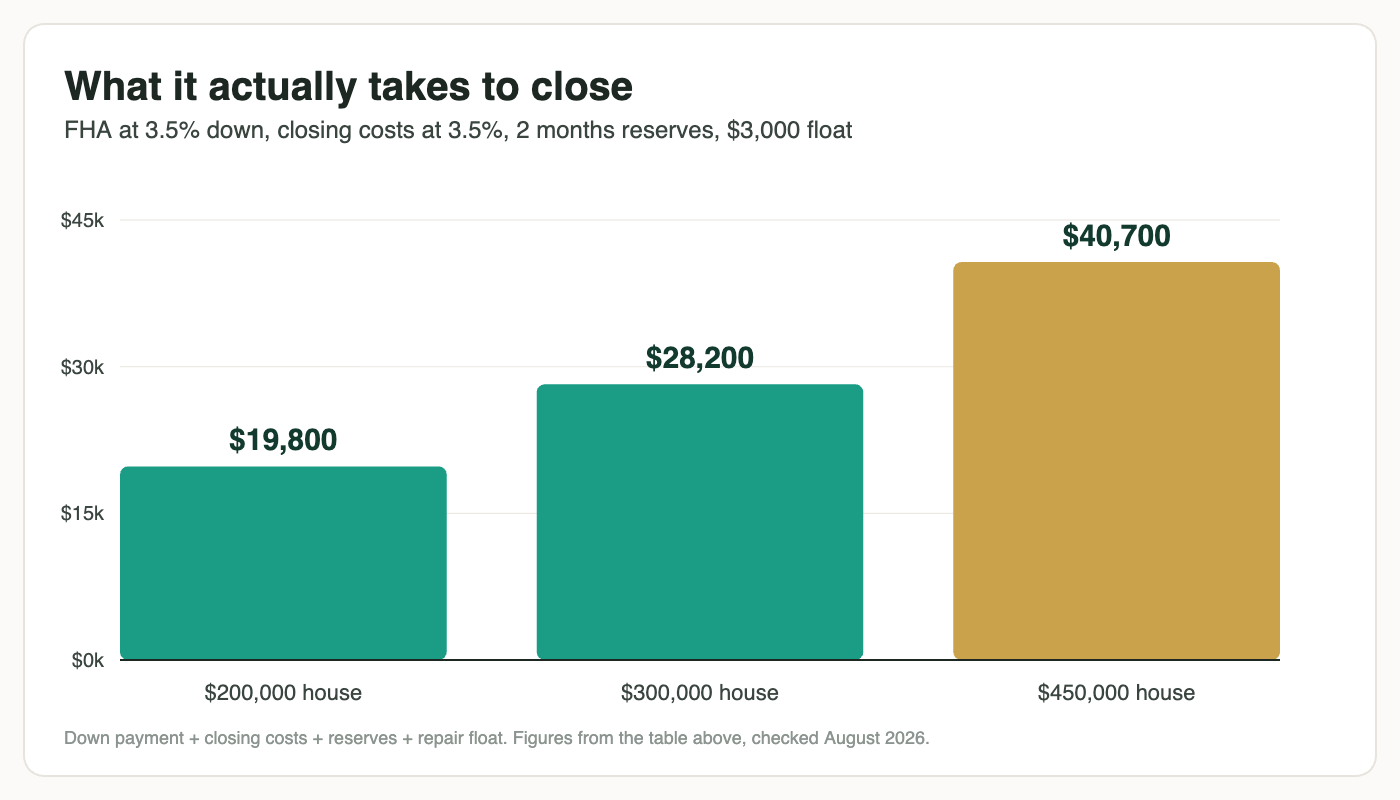
Now the encouraging part: assistance attacks the two biggest rows. A program covering $10,000 of down payment and closing costs turns the $200,000 column into roughly $10,000 of your own savings. That is a reachable number, and it is the actual answer to how much you should save: the four buckets for your price range, minus whatever a program will carry for you.
This page is education and my own experience, not advice; your lender and a housing counselor run your numbers.
Turn the four buckets into your own target.
The free down-payment budget tool. Enter your price range and timeline and it breaks the total into a monthly savings number you can actually act on.
Then see what the monthly side looks like once you own it: the free house hacking calculator takes a price, a rent and your loan terms and returns your effective monthly cost, no account needed.
Frequently asked questions
Do I really not need 20% down?
You do not. 20% is the point where conventional loans drop mortgage insurance, nothing more. Conventional allows 3% down for first-time buyers, FHA 3.5% with a credit score of 580 or higher, and VA and USDA go to zero for eligible buyers. You trade a smaller down payment for a monthly insurance cost.
Can I roll closing costs into the mortgage?
On a purchase, mostly no. The workarounds are seller credits negotiated in your offer, lender credits in exchange for a higher rate, and assistance programs that pay closing costs directly.
Can my down payment be a gift?
Yes. Both FHA and conventional loans accept gift funds from family for the down payment and closing costs, with a paper trail documenting the gift. Your lender will want a gift letter.
How much should I keep in savings after closing?
Beyond anything your lender requires, I would not close with less than two months of the full housing payment in reserve, and a repair float on top. The first year of owning is when the surprises cluster.
What are closing costs?
Closing costs are defined as the fees due at settlement beyond the down payment, covering lender charges, title work, the appraisal, recording fees and prepaid taxes and insurance.
Sources: Freddie Mac, What Are Closing Costs and How Much Will I Pay? (2% to 5% range, itemized fees; last reviewed February 26, 2026) · Fannie Mae eligibility and pricing (3% and 5% down LTV limits) · HUD Mortgagee Letter 2023-05 (FHA MIP rates). All checked August 19, 2026.
Closing with nothing left is one of the errors in first-time home buyer mistakes, alongside spending the full approval and skipping down payment assistance.
Get started with the newsletter!
Useful, relevant analysis, tools, tricks, and what you need to know on the journey to financial freedom. From the van years to a duplex, the plain math and none of the hype.
Subscribe and get the free $0-to-First-Property Roadmap to start.
No spam. Unsubscribe in one click.
Want the deeper toolkit? The guides and spreadsheets are in the shop, from $5, and the free tools stay free either way.
Sources
- [S1] USDA Rural Development, modified 2026-06-22, read 24 September 2026: “Applicants must: Meet income-eligibility (cannot exceed 115% of median household income)” www.rd.usda.gov.
- [S2] U.S. Department of Housing and Urban Development (HUD), checked September 2026: FHA’s minimum down payment on a one-to-four-unit home you live in is 3.5% with a credit score of 580 or higher, and 10% with a score of 500 to 579. www.hud.gov.