
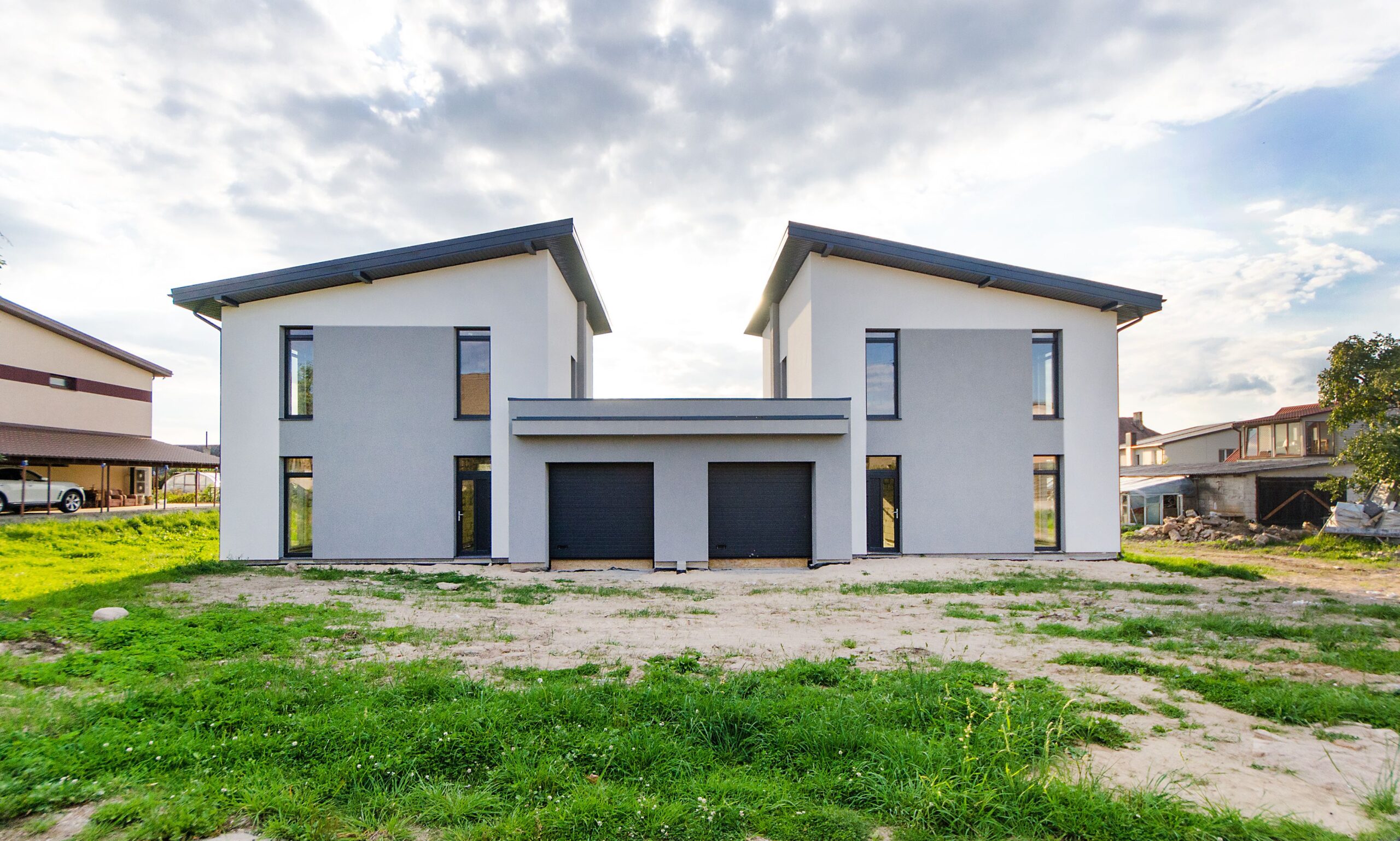
The 21st Century ROAD to Housing Act bars large institutional investors, meaning for profit companies that control 350 or more homes, from buying any single family home. The law defines a single family home as a structure with two or fewer dwelling units, so duplexes are covered alongside detached houses. The ban starts January 7, 2027, applies only to new purchases, and expires 15 years after that.
Published August 18, 2026. This post covers Public Law 119-101, enacted July 11, 2026, which takes effect January 7, 2027. Every fact below comes from the text of the law as published by the Government Publishing Office, linked in the sources at the end.
When I bought my duplex, the thing I worried about most was getting outbid by somebody with more cash than me. So a federal law that tells large investors they can no longer buy the kind of building I was shopping for is worth understanding properly rather than from a headline.
What the coverage left out
Most coverage of this law says it stops big investors from buying single family homes. That is correct, but it leaves out the part that matters if you are looking at two unit buildings: the law writes its own definition of single family home, and that definition includes duplexes.
The five things the law does
- Blocks new purchases. A large institutional investor may not buy, or sign a contract to buy, a single family home.
- Sets the size test at 350 homes. The rule only reaches companies with investment control of 350 or more homes.
- Defines a single family home as two units or fewer. Duplexes are in. Manufactured homes are out.
- Leaves existing portfolios alone. Nobody has to sell anything they already owned.
- Fines violations at up to $1 million per violation, or three times the purchase price, whichever is larger, and sends that money to first time buyer assistance.
The definition most coverage leaves out
Section 1001 of the law defines the term this way: a single family home “means a structure that contains 2 or fewer dwelling units that are each intended for residential occupancy by a single household,” and it “does not include a manufactured home.”
Read that twice if you are shopping for a duplex. A two unit building is a single family home for the purposes of this ban. A triplex is not. A fourplex is not. A manufactured home is not, no matter how many units it has.
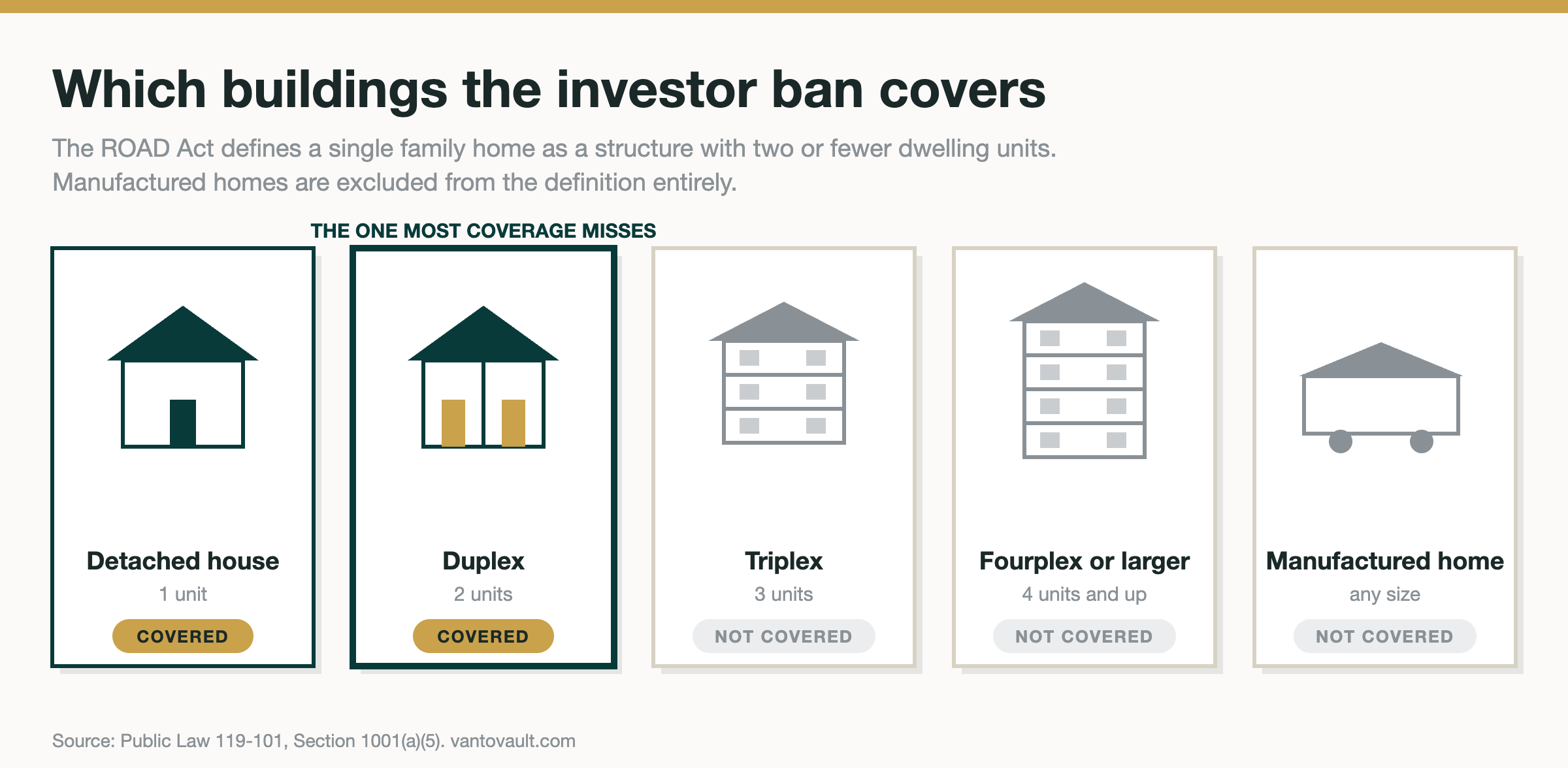
This matters because the duplex is the entry point for a lot of first time buyers. It is the smallest building where somebody else’s rent can help cover your mortgage, and it is the building type I write about most on this site. If you want the background, I have a plain English guide to what house hacking is and a walkthrough of how to buy a duplex and live in one side.
Who counts as a large institutional investor
The law is aimed at a specific kind of buyer, and the test has two halves. A company is covered when it is a for profit entity in the business of investing in, owning, renting, managing or holding single family homes, and it has investment control of at least 350 of them, either alone or acting in concert with other companies.
Investment control is defined broadly, so a company cannot escape the rule by putting the homes in a subsidiary. It counts if the company:
- Owns the home, or holds primary authority over investment or management decisions about it
- Is, or controls, the general partner or managing member of the entity that owns it
- Is, or controls, the investment manager, management company or investment advisor of the owner
- Owns or controls more than 25 percent of any class of equity in the owner, unless it is a passive investor
- Otherwise controls the entity that owns the home
Government entities at every level are excluded, so a city land bank or a housing authority is not caught by this. Neither is a small landlord. If you own three rentals, or thirty, this law does not apply to you.
The exceptions are the part worth reading closely
The ban comes with eleven categories of excepted purchase. Some are narrow. Several are wide enough that a large investor with good lawyers has room to keep buying. Here they are in plain terms.
| Exception | What it allows |
|---|---|
| Build to rent | Buying or building brand new homes to run as rentals, including whole rental only communities |
| Renovate to rent | Buying homes that fail building code and spending at least 15 percent of the purchase price fixing them |
| New construction and conversions | Newly built, renovated or converted homes sold by the investor rather than rented out while waiting to sell |
| Rent to own programs | Programs with a contract, rent reporting to credit bureaus, and meaningful price concessions from the investor |
| Homeownership programs | Programs offering renters credit reporting, a right of first refusal, and a 30 day first look |
| Debt collection | Taking a home back to satisfy a debt the investor had a contractual right to collect |
| Foreclosure and servicing | Homes picked up through foreclosure, deed in lieu, or loss mitigation, so long as it is not a long term investment play |
| Buying from another large investor | Homes already held by a covered investor before the law, or bought in compliance with it |
| Buying from a smaller investor | Purchases from investors not covered by the law, but only for two years after the ban starts |
| Age restricted communities | Housing built or converted for households with a member aged 55 or older |
| Combinations | Any mix of the above |
The build to rent carve out is the one to watch. A company that is blocked from buying an existing duplex is not blocked from building new rental housing and keeping it. Whether that shifts investor money away from resale listings and toward new construction is the open question, and nobody will be able to answer it until the reports Congress ordered start landing.
What this changes if you are buying your first property

I want to be careful here, because the answer depends heavily on where you are looking, and I would rather give you the range than a promise.
In markets where corporate ownership is concentrated, this could change who you bid against. Senator Warnock’s office, which authored this piece of the bill, says corporate investors own more than 72,000 single family rental homes in metro Atlanta, which is more than one in four such properties in the region. Taking the largest buyers out of the bidding in a market like that is a meaningful change in who you compete with.
What it looks like in most of the country
In most of the country, the picture is different. Economists interviewed after the law passed pointed out that institutional buying is a small share of purchases in many markets, including some of the ones people assume are dominated by it. If large investors were not competing for the duplex you want, removing them does not change your odds.
So the useful way to think about it is local. Two questions tell you whether this law touches your search:
- Are two unit buildings in your market being bought by companies rather than people? County records show the buyer name on recent sales, and a string of LLC purchases on the same street is the signal.
- Is new rental construction happening near you? If it is, the build to rent exception means investor money has somewhere legal to go, and it may go there instead of leaving your market.
Either way, the number that decides whether a specific building works for you is your monthly cost after rent, not the level of investor competition. I broke that math down using three real price points in what a duplex costs per month.
The dates that matter
| Date | What happens |
|---|---|
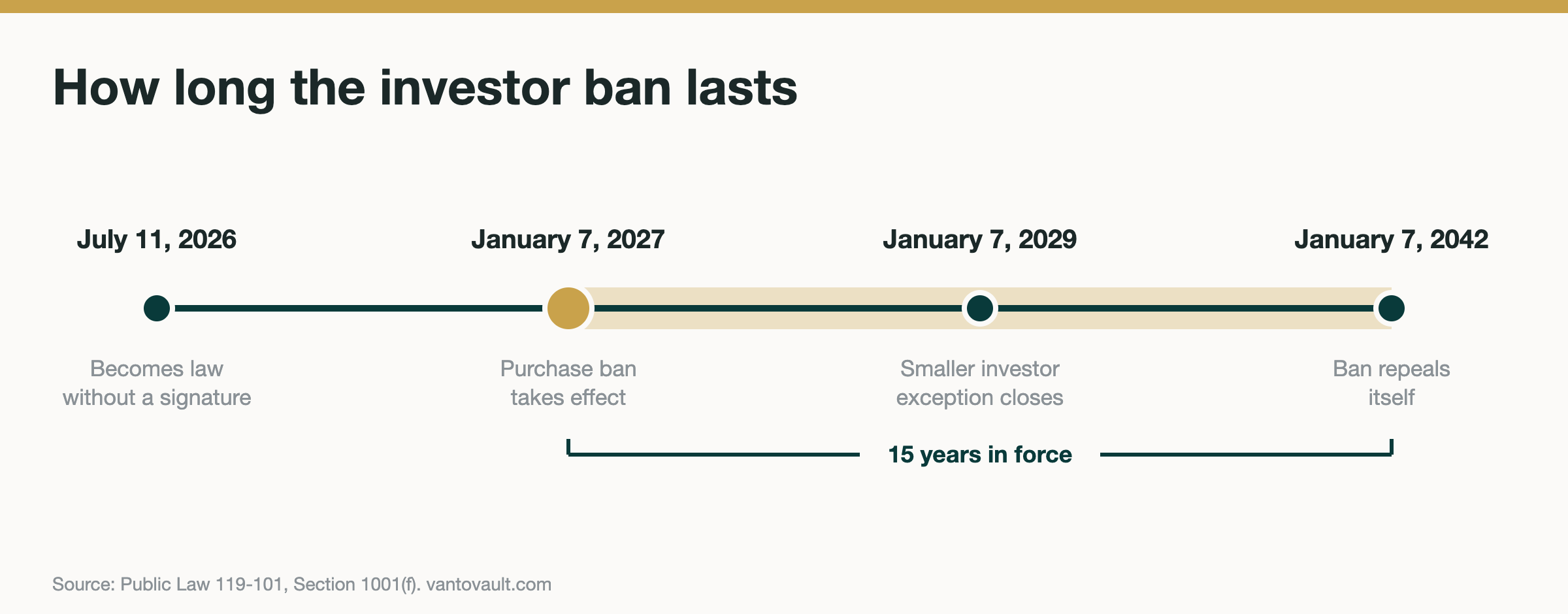
| July 11, 2026 | The law is enacted after ten days pass without a presidential signature |
| January 7, 2027 | The purchase ban and the penalties take effect, 180 days after enactment |
| January 7, 2027 | A toll free number and website open for renters of investor owned homes, and covered investors file their first report of how many homes they hold and where |
| January 7, 2029 | The exception for buying from smaller investors closes, two years in |
| January 2029 and 2037 | Congress receives reports from the Government Accountability Office and from Housing and Urban Development on whether the ban worked |
| January 7, 2042 | The ban repeals itself, 15 years after it started |
What the law does not do
This is the part I would want to know before getting my hopes up, so I will put it plainly.
- It does not force anybody to sell. Every home a large investor already owns stays owned. The ban is on future purchases only.
- It does not spend any money. The final section of the entire Act, Section 1202, authorizes no additional funds. The first time buyer assistance funded by penalties only exists if penalties are collected and Congress appropriates the money.
- It does not cover buildings with three or more units, and it does not cover manufactured homes.
- It does not stop investors from building. Build to rent is expressly allowed.
- It does not last. The whole prohibition disappears in January 2042 unless a future Congress renews it.
The fine print that cuts the other way
One more piece of fine print that cuts the other way, in favor of the ban holding its shape: the Treasury Department is allowed to write rules to carry the section out, but the law expressly forbids those rules from changing the definitions, narrowing the goal of getting more homes into the hands of individual buyers, adding new categories of exempt investor, or moving the 350 home threshold. That is unusually tight drafting, and it means the scope of this ban is fixed by Congress rather than by whoever runs Treasury. As of October 6, 2026, we found no Treasury rules under Section 1001, though HUD’s August 10 and September 23, 2026 reverse-mortgage loan sale notices already ask bidders to attest that they comply with the Act’s investor restrictions.
The diagrams in this post are free to republish with attribution. Copy-paste embed code is on the charts page.
Whether a duplex works for you comes down to your monthly cost after the other unit’s rent, and that is a number you can get in about a minute. The free house hacking calculator takes a price, a rent, and your loan terms and returns your effective monthly cost, with no account and no email required. The “Copy link to these results” button gives you a link that reopens your exact numbers later.
Common questions
Does the ROAD Act investor ban apply to duplexes?
Yes. Section 1001 defines a single family home as a structure that contains two or fewer dwelling units, so a duplex is covered by the ban in the same way a detached house is. Buildings with three or more units are not covered.
Who counts as a large institutional investor?
A for profit company that is in the business of investing in, owning, renting, managing or holding single family homes and that has investment control of 350 or more of them, either on its own or acting together with other companies. Government entities are excluded, and so are ordinary small landlords.
When does the ROAD Act investor ban take effect?
January 7, 2027, which is 180 days after the law was enacted on July 11, 2026. The ban repeals itself 15 years later, on January 7, 2042.
Does the law force investors to sell the homes they already own?
No. The ban applies only to new purchases. The law states expressly that nothing in the section requires a large institutional investor to divest or sell any home purchased before the date of enactment.
Are manufactured homes covered?
No. The definition of single family home in the law excludes manufactured homes as defined by the National Manufactured Housing Construction and Safety Standards Act of 1974.
What is the penalty for violating the ban?
Up to one million dollars per violation, or three times the purchase price of the home, whichever is greater. Penalties collected go to the HOME Investment Partnerships program to fund assistance for first time buyers, including down payments, closing costs and interest rate buydowns.
Get started with the newsletter!
Useful, relevant analysis, tools, tricks, and what you need to know on the journey to financial freedom. From the van years to a duplex, the plain math and none of the hype.
Subscribe and get the free $0-to-First-Property Roadmap to start.
No spam. Unsubscribe in one click.
Want the deeper toolkit? The guides and spreadsheets are in the shop, from $5, and the free tools stay free either way.
Sources
- 21st Century ROAD to Housing Act, Public Law 119-101, U.S. Government Publishing Office. Section 1001 begins at 140 Stat. 976. All definitions, exceptions, penalties and dates in this post come from this text.
- Single-family investor restrictions take effect under ROAD Act, HousingWire, July 14, 2026. Source of the metro Atlanta ownership figure attributed to Senator Warnock’s office.
- What the 21st Century ROAD to Housing Act means for homebuyers and sellers, CNBC, July 11, 2026. Source of the point that institutional purchase activity is light in many markets.
- Institutional Investors and Single-Family Housing: In Brief, Congressional Research Service, June 30, 2026.