
A small dollar mortgage is a home loan of $100,000 or less. Lenders write very few of them, because the cost of originating a loan is roughly the same whether the loan is $70,000 or $700,000, and loan officers are usually paid a percentage of loan size. The ROAD Act lets the Federal Housing Administration create an optional pilot that could pay lenders and give buyers grants for down payments and closing costs, plus two studies of why the loans are so scarce. As of October 6, 2026, HUD has announced no pilot.
Published August 18, 2026. This post covers Sections 105, 401 and 402 of Public Law 119-101, enacted July 11, 2026. Statistics on small dollar lending come from Urban Institute research published in 2018 using 2015 and 2017 data, which remains the most cited work on the subject.
Almost everything I write on this site rests on one idea: the cheapest way into property ownership is to buy in a market where buildings are cheap. Run the numbers on a $160,000 duplex and the math works in a way it never will on a $600,000 one.
The hole in that idea
There is a hole in that idea, and I want to be upfront about it. Cheap buildings exist. Loans to buy cheap buildings often do not. The ROAD Act is the first federal law I know of that treats this as a problem worth naming and testing solutions for.
The size of the problem
Urban Institute researchers Laurie Goodman and Bing Bai looked at what happens to buyers at the bottom of the price range. Two findings stand out.
- Cheap homes mostly get bought with cash. In 2015, almost 80 percent of homes valued between $70,000 and $150,000 were bought with a mortgage. For homes selling at $70,000 or less, only about a quarter were.
- Small loan applications get denied more, and credit is not the reason. After controlling for how creditworthy applicants were, the denial rate ran to 52 percent for the smallest loans against 29 percent for loans above $150,000. The share of weaker credit applicants was almost identical across loan sizes: 34 percent for loans up to $70,000, 35 percent in the middle, 30 percent above $150,000.
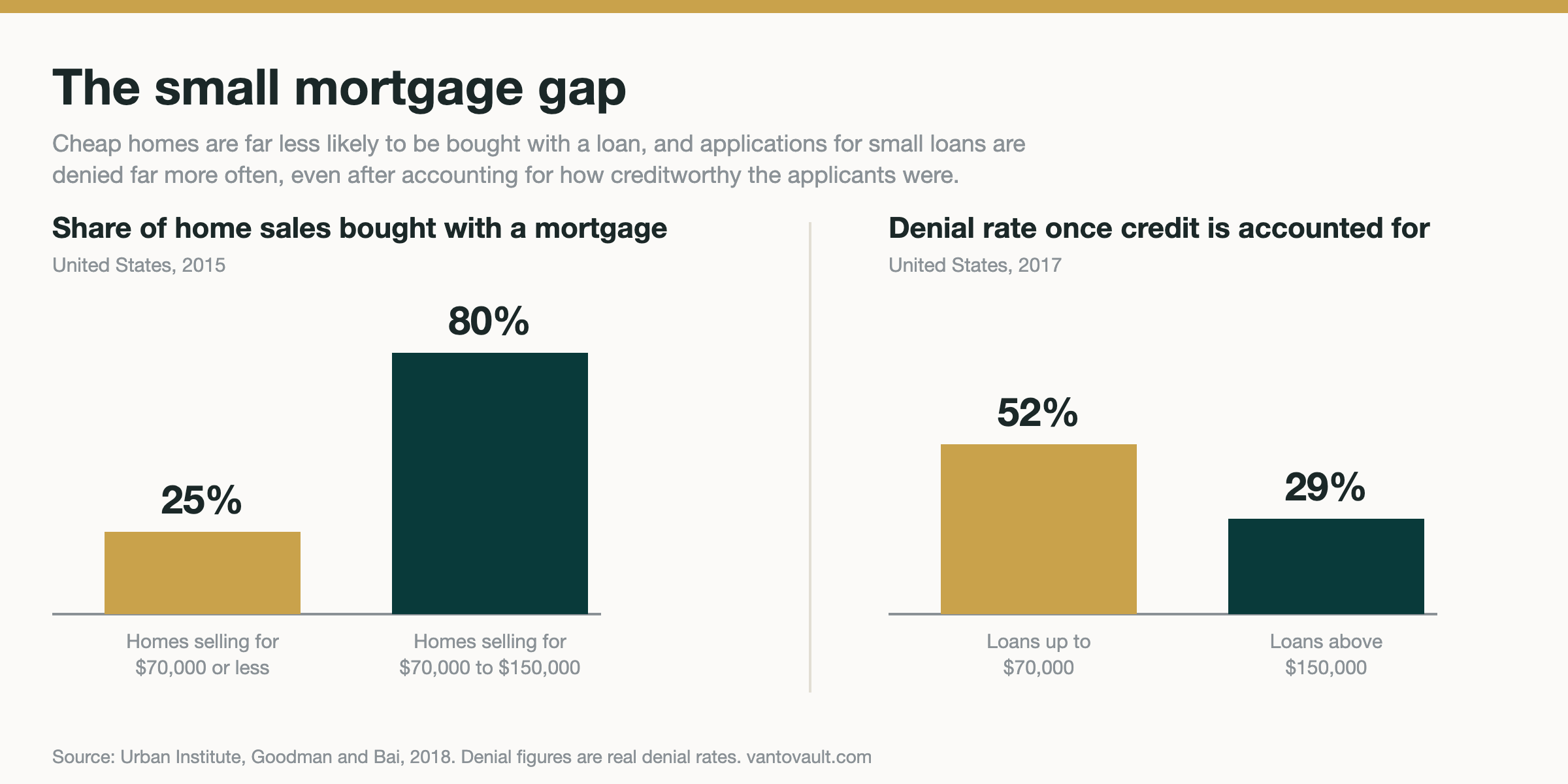
If you have ever wondered why a $70,000 house sits on the market while a $400,000 house three towns over sells in a weekend, this is a large part of the answer. The buyer for the cheap house often cannot get financed, so the buyer for the cheap house is frequently an investor paying cash.
Why lenders avoid these loans
It is not a conspiracy. It is arithmetic. Underwriting a mortgage costs a lender roughly the same in staff time, compliance and paperwork whether the loan is $70,000 or $700,000. The revenue, though, scales with loan size. So the small loan earns a fraction of the revenue for the same amount of work.
What Section 401 orders the regulators to do
The ROAD Act says this out loud. Section 401 orders the Consumer Financial Protection Bureau, the federal agency that writes mortgage rules, to report on how loan originators are paid across the market, and specifically on how often they are paid a commission set as a fixed percentage of the amount borrowed. When a loan officer earns a percentage, a $70,000 loan pays them a tenth of what a $700,000 loan pays for a similar day of work.
What Section 402 changes about points and fees
Section 402 goes after a second obstacle. Federal rules cap the points and fees on a qualified mortgage as a percentage of the loan. On a small loan, ordinary fixed closing costs can blow through that percentage cap, which pushes the loan outside the safe category most lenders will write. The Act directs the CFPB, with Housing and Urban Development and the Federal Housing Finance Agency, to evaluate how those thresholds affect small loan originations.
What the law authorizes
Section 105 is the piece with teeth, and it is worth reading carefully because of what it permits.
The Federal Housing Commissioner may set up a pilot program to increase access to mortgages of $100,000 or less on properties of one to four units that the borrower lives in. Note the unit count: a duplex qualifies. Inside that pilot, the law permits four things that do not normally exist together.
- Direct payments to lenders to make writing the small loan worth their while
- Adjusted FHA terms and costs specifically for small dollar mortgages
- Direct grants to buyers covering down payments, closing costs, appraisals and title insurance
- Outreach and technical assistance so borrowers and lenders know the program exists
That third item is the one to watch. A federal grant covering the down payment and the closing costs on a sub $100,000 duplex would change the arithmetic for a first time buyer more than almost anything else in this law.
The three sections side by side
| Section | What it does | Binding | Deadline |
|---|---|---|---|
| 105, FHA Small-Dollar Mortgages | Permits an FHA pilot for loans of $100,000 or less on 1 to 4 unit owner occupied homes, including lender payments and buyer grants | No, the law says the Commissioner “may” establish it | May be set up by July 2027; no new pilot can be created after July 2029 |
| 401, Small-Dollar Loan Originators | Report to Congress on how loan originators are compensated and whether percentage based pay suppresses small lending | Yes, but it produces a report, not a rule | About April 2027 |
| 402, Points and Fees | Evaluation of how the qualified mortgage points and fees caps affect loans under $100,000 | Yes, but it produces an evaluation, not a rule | About April 2027 |
What this does not do
- It does not create the pilot. It permits one. The law uses the word “may,” and if the Commissioner never acts, nothing happens.
- It does not fund anything. Section 1202 of the Act authorizes no additional money, so the pilot depends on appropriations.
- It does not change the points and fees caps. Section 402 studies them. Despite the section heading, it amends nothing.
- It does not change originator pay rules. Section 401 is a report.
- It expires. HUD is to set the pilot up within one year, it sunsets four years after it starts, and no new pilot may start more than three years after enactment.
So the accurate way to describe this part of the law is that Congress diagnosed the problem correctly and authorized an experiment. Whether the experiment happens is a separate question. The law says it may be set up by July 2027, and no new pilot can be created after July 2029.
Why this matters more than the investor ban for most buyers
The part of this law that got the headlines was the ban on large investors buying single family homes, which I covered in the ROAD Act investor ban and why it covers duplexes. That ban only helps you if large investors were bidding against you in the first place.
The small dollar mortgage problem affects you in every low cost market in the country, whether investors are present or not. If you are looking at buildings in the $80,000 to $150,000 range, the constraint on you is usually financing, not competition. That is the constraint Section 105 is aimed at.
What to do until the pilot exists
Until the pilot exists, the practical workarounds are the ones that already exist: FHA financing with its low down payment, credit unions and small local banks that hold loans on their own books, and down payment assistance programs run by state and city housing agencies.
The chart in this post is free to republish with attribution. Copy-paste embed code is on the charts page.
If you are weighing a lower priced duplex, the number that decides it is your monthly cost once the other unit’s rent comes in. The free house hacking calculator takes a price, a rent and your loan terms and gives you that figure in about a minute, with no account and no email required.
Common questions
What is a small dollar mortgage?
A home loan of $100,000 or less. The ROAD Act uses that threshold in Sections 105, 401 and 402. Some research, including the Urban Institute work cited here, uses a tighter cutoff of $70,000.
Why is it hard to get a mortgage on a cheap house?
The cost to a lender of underwriting and servicing a loan is roughly fixed, while revenue scales with loan size, so a small loan earns far less for the same work. Loan officers are also frequently paid a percentage of the amount borrowed, which makes small loans unattractive to originate. Urban Institute research found that higher denial rates on small loans are not explained by applicant creditworthiness.
Does the FHA small dollar pilot cover duplexes?
Yes. Section 105 defines a small dollar mortgage as one secured by a one to four unit property that is the principal residence of the borrower, so a duplex you live in qualifies.
Could the pilot pay my down payment?
The law permits it. Section 105 allows direct grants to borrowers covering down payments, closing costs, appraisals and title insurance. It does not require the program to exist or fund it, so this is permission rather than an available benefit.
When would the pilot start?
There is no start date yet. The law says the Federal Housing Commissioner may set it up not later than one year after enactment, which is July 2027, and no new pilot can be created after three years, which is July 2029. Once established, the pilot itself runs four years.
Get started with the newsletter!
Useful, relevant analysis, tools, tricks, and what you need to know on the journey to financial freedom. From the van years to a duplex, the plain math and none of the hype.
Subscribe and get the free $0-to-First-Property Roadmap to start.
No spam. Unsubscribe in one click.
Want the deeper toolkit? The guides and spreadsheets are in the shop, from $5, and the free tools stay free either way.
Sources
- 21st Century ROAD to Housing Act, Public Law 119-101, U.S. Government Publishing Office. Section 105 at 140 Stat. 852, Sections 401 and 402 at 140 Stat. 897.
- Why do lenders deny small-dollar mortgages at higher rates?, Laurie Goodman and Bing Bai, Urban Institute, July 31, 2018. Source of the mortgage share and real denial rate figures.
- Financing Lower-Priced Homes: Small Mortgage Loans, U.S. Department of Housing and Urban Development, Office of Policy Development and Research.
- [S1] www.govinfo.gov, Pub. L. 119-101, July 11, 2026, read 24 September 2026. www.govinfo.gov.