

Search this question and you find two kinds of answers: vague ones that say it depends, and guru ones quoting somebody clearing $4,000 a month without showing an address, loan terms or expenses. Neither helps you decide anything. Here is a third kind: my own duplex, itemized, with a way to translate it to your market.
Rates in this post are a snapshot. The payment figures below are calculated at a 30-year fixed rate of 6.66%, the Freddie Mac Primary Mortgage Market Survey average for the week ending July 30, 2026. Rates have moved since; the figures here have not been recalculated.
The short version is that a house hack will not hand you a salary, and mine does not. It removes most of the largest expense you have while tenants retire a loan on your behalf, and those two effects together move my position by roughly $39,000 in an illustrative year.
House hacking income example: a $470,000 duplex
The building cost $470,000. I bought it with an FHA loan at 3.5% down, $16,450, at a rate under 4%. The full monthly payment with taxes and insurance is about $2,880. I live in one unit, the upstairs tenant pays about $1,200 a month, and the basement runs as an Airbnb.
| Channel | Annual value | Cash or equity |
|---|---|---|
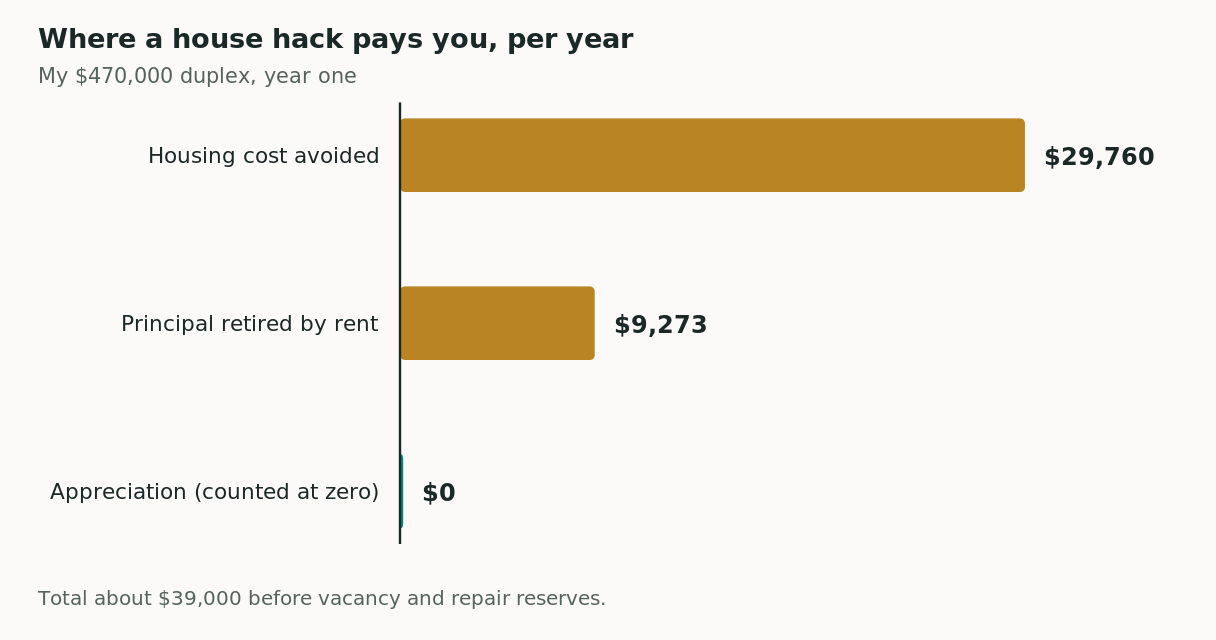
| Housing cost avoided | $29,760 | cash kept |
| Principal retired by rent | $9,273 | equity |
| Appreciation | counted at $0 | equity |
| Total | about $39,000 | |
| Less vacancy and repair reserves | about $5,000 | |
| Kept after reserves (cash + equity) | about $34,000 |
Those lines break down as follows. Without tenants the building would cost me about $2,880 a month, or roughly $34,560 a year. After the upstairs rent I am at about $1,680, and after basement income my effective housing cost most months lands in the few-hundred range. For an illustrative year, call it $400, or $4,800 a year (the ledger posts carry the exact figures), which puts the housing offset at $29,760.
On the principal side, a $453,550 loan retires $9,273 of balance in year one, an average of $773 a month, and my tenants’ rent covers substantially more than that. Appreciation I count at zero on purpose, because it is the one channel I cannot control or predict.
Figures are approximate; the ledger posts carry the exact numbers.
Three ways house hacking pays you
Separating those channels matters, because confusing them is where bad math starts.
- Housing cost you no longer pay. Rent from the other unit offsets your payment. This is the largest effect for most house hackers and it never appears in a bank statement as income, which is why people underrate it. A dollar you did not spend on housing buys what a dollar of salary buys, without the payroll tax.
- Principal your tenants retire. Part of every mortgage payment reduces the loan balance, funded substantially by rent. You cannot spend it this month; it appears when you sell or refinance. Note that this channel shrinks at higher rates. The same loan at the 6.66% average of July 2026 retires about $4,900 in year one rather than $9,273, because more of each payment goes to interest.
- Appreciation. The building may gain value. I treat it as a bonus rather than a plan, and every figure above counts it at zero.

Costs that reduce house hacking income
Those figures are gross of the things that make property ownership what it is, and leaving them out is how the screenshots get manufactured.
- Vacancy. The upstairs unit will sit empty between tenants eventually. A month costs me about $1,200, so I budget for it every year whether it happens or not.
- Repairs and capital expenses. Furnaces, roofs and water heaters fail on their own schedule. A sane budget sets money aside monthly for the big items even in years when nothing breaks. I walk through the standard percentages in the duplex math, line by line.
- The short-term rental is a part-time job. Basement income is the difference between a cheap month and a nearly free one, and it is earned. Cleaning turnovers, messaging guests and keeping the calendar full take steady hours. Anyone describing short-term rental income as passive has never hosted.
- Taxes cut both ways. Rental income is taxable, and there are meaningful deductions against the rented portion of an owner-occupied building. The net depends on your situation. This is a place to pay for personal advice rather than follow a blog post.
After reserves for vacancy and repairs, the cash I keep is closer to $24,760 a year, with about $9,273 more building as equity through principal paydown, so the roughly $34,000 after reserves is cash and equity together, not all in pocket. I would rather publish the smaller durable figure than the larger fragile one. The full first-year accounting, including the bad months, is in the duplex, year one.

How much can you make house hacking at today’s rates?
My deal was underwritten at a rate under 4%, and the same building at 6.66% costs about $970 a month more to carry, so translate the framework rather than my totals. Outcomes I see when running listings fall into three bands.
| Band | What the rent covers | Your effective housing cost | How common |
|---|---|---|---|
| Cost cut in half | Half the payment or more | Roughly half what renting would cost, with equity paydown on top | The common case |
| Cost near zero | Nearly the whole payment | Approaching zero | Reachable, usually only with an extra unit or a basement that is work |
| Cash in your pocket | More than the whole payment | Negative, money arrives | Rare at current rates |
- In strong price-to-rent markets, a well-bought duplex at today’s rates cuts housing cost by half or more, with equity paydown on top. That is the common case and an excellent one, even though no cash arrives in your account.
- In the best deals, rent covers nearly the whole payment and housing cost approaches zero. My building reaches this band only because of the basement, and the basement is work.
- Deals where you pocket meaningful monthly cash while living in the building are rare at current rates, and listings promising them usually hide the reason in the expense column. If one survives conservative numbers, move quickly.
Finding your band takes about two minutes. The free calculator computes effective housing cost from a listing, and the projection tool extends it across ten years so you can watch the offset and paydown compound. Both are free, no account, no email wall.
Run a building through the math instead of guessing at it.
The free house hacking calculator. Put in a price, a rent and your loan terms, and it returns your real monthly cost in a few seconds.
Frequently asked questions
How much can you make house hacking?
House hacking income is defined as housing cost avoided plus tenant-funded principal paydown plus appreciation. On my $470,000 duplex that totals about $39,000 a year, or roughly $34,000 after vacancy and repair reserves. Of the $29,760 cash channel, about $24,760 is left once those reserves are set aside. All of it is money not spent, not money received.
Can house hacking replace my job income?
Job replacement is defined as rental income exceeding your total living expenses, which a single house hack does not reach. One house hack replaces most of a housing bill, equivalent to a $10,000 to $30,000 raise depending on market. Replacing employment income generally requires repeating the process across several buildings over years.
How much did you make in year one?
Year one produced no check. My housing cost fell from about $2,880 a month to a few hundred, and the loan balance dropped $9,273, which compounds to the same place as income without passing through a bank statement.
Is house hacking income taxable?
Rent you collect is defined as taxable rental income, reportable on Schedule E, and it is offset by deductions against the rented portion of the property including depreciation. The net effect varies enough by situation that it is worth an hour with a tax professional.
Keep going
- Ten-year projection tool, watch the offset and paydown compound.
- The duplex math, line by line, the expense lines beginners leave out.
- The duplex, year one, the full first-year accounting.
- Is house hacking still worth it in 2026?, the same duplex tested against today’s rates.
Get started with the newsletter!
Useful, relevant analysis, tools, tricks, and what you need to know on the journey to financial freedom. From the van years to a duplex, the plain math and none of the hype.
Subscribe and get the free $0-to-First-Property Roadmap to start.
No spam. Unsubscribe in one click.
Want the deeper toolkit? The guides and spreadsheets are in the shop, from $5, and the free tools stay free either way.
Sources
- Freddie Mac, Primary Mortgage Market Survey, week of July 30, 2026 (30-year fixed average 6.66%). freddiemac.com/pmms
- HUD, FHA Single Family Housing Policy Handbook 4000.1 (minimum 3.5% down, owner-occupied one-to-four-unit). hud.gov
Where my figures come from: Purchase price, loan terms, payment, rent and amortization figures are from my own duplex closing documents and monthly statements.
If you want to know what a house hack would produce for you, run a listing through the calculator, then stretch it over a decade in the projection tool. And if the result raises questions, send me the deal. I read every one.
Related: for how the long-term and short-term income break down side by side, see short-term vs. long-term rental: what I learned running both.