
The ROAD Act changed four words in federal law. A manufactured home used to mean a factory built house on a permanent chassis. It now means a factory built house built with or without a permanent chassis. That one edit opens a path toward HUD certification for compact factory built homes that were shut out before, and it starts a clock: most states have until July 2027 to certify that they treat chassis free homes the same as conventional ones for financing, title, insurance and taxes, or they must stop their sale.
Published August 18, 2026. This post covers Sections 301 through 304 of Public Law 119-101, enacted July 11, 2026. The amended definition quoted below is the current text of 42 U.S.C. 5402(6) as published by the Office of the Law Revision Counsel.
I spent thirteen months living in a van before I owned anything. So I pay close attention when federal law changes what counts as a house, because the line between a dwelling and a vehicle is the line between a mortgage and a much worse loan.
Why the chassis rule is the least covered part of the law
The ROAD Act moved that line. It is the least covered part of the law and it may be the most consequential for anyone whose route into ownership runs through something other than a conventional house.
The chassis, and why it mattered
A chassis is the steel frame with the axles that federal law required under manufactured homes since 1974, which pushed them toward chattel loans.
A chassis is the steel frame a manufactured home is built on, the part with the axles. Since 1974, federal law defined a manufactured home as a structure built on a permanent chassis. The frame had to stay under the house forever, even after the house was set on a foundation and the wheels came off.
Why the chassis requirement mattered
That requirement is a large part of why these homes have been treated as vehicles rather than real estate. A house with a permanent steel frame under it looks, to a county recorder and to a lender, like something that could be towed away. So it often gets titled like a car and financed with a chattel loan, which is a loan secured by personal property. Chattel loans carry higher rates and shorter terms than mortgages, which is why owners of manufactured homes frequently pay more to borrow less.
Section 301 of the ROAD Act struck the phrase “on a permanent chassis” and inserted “with or without a permanent chassis.” The definition now reads, in relevant part:
“manufactured home” means a structure, transportable in one or more sections, which, in the traveling mode, is eight body feet or more in width or forty body feet or more in length, or, when erected on site, is three hundred twenty or more square feet, and which is built with or without a permanent chassis and designed to be used as a dwelling…
42 U.S.C. 5402(6), as amended by Public Law 119-101
Where tiny homes sit in this
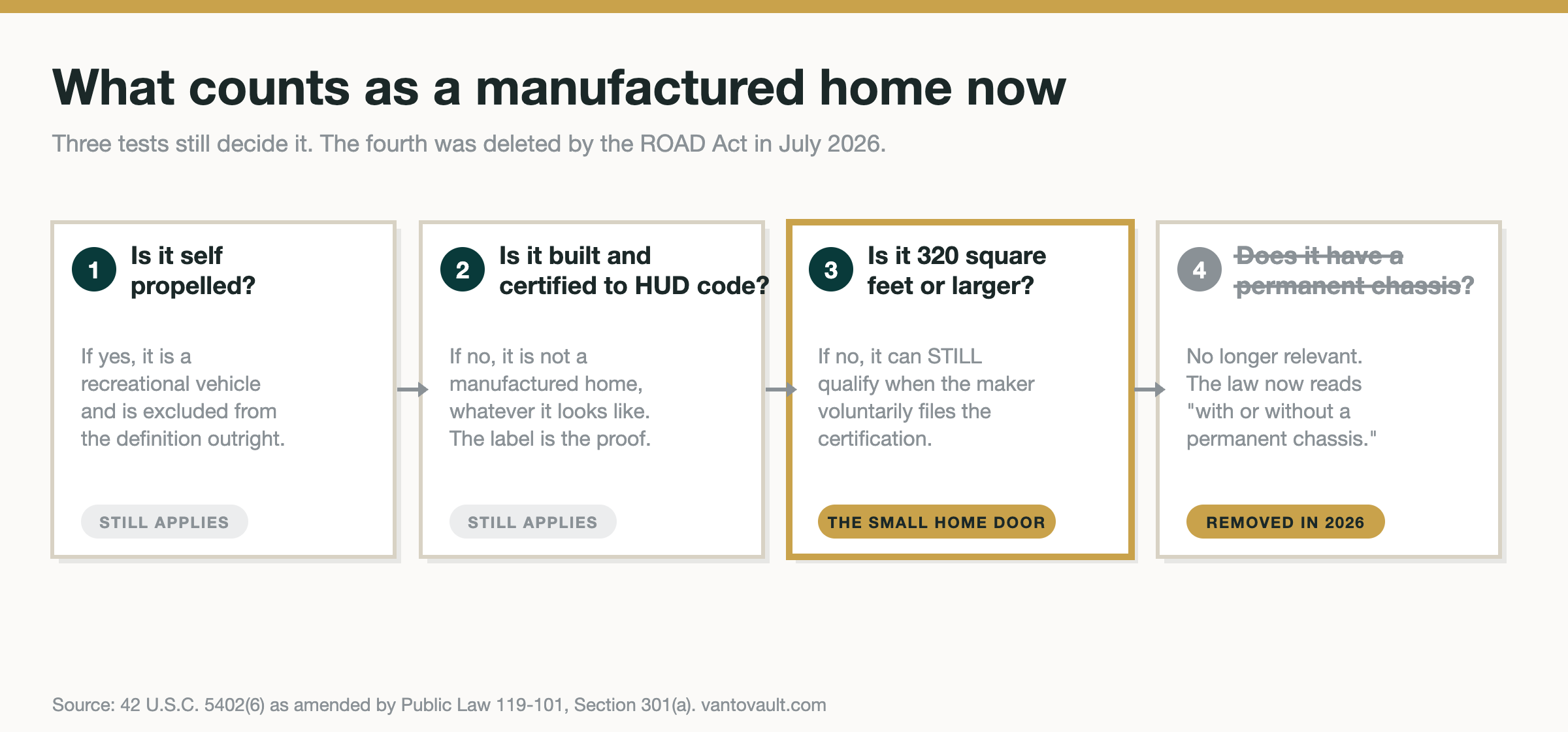
Most tiny homes fall under the 320 square foot floor, but a builder can voluntarily certify a smaller home to HUD code and it counts.
Does a tiny home qualify as a manufactured home?
This is the question I expect people to arrive with, so let me answer it precisely, because the details decide it.
The definition has a size floor. A manufactured home is normally at least 320 square feet when set up on site, or eight feet wide or forty feet long in traveling mode. Most tiny homes are smaller than that.
The 1980 exception that is easy to miss
But the same paragraph carries an exception that has been in the law since 1980 and is easy to miss. The term also covers any structure that meets every requirement except the size requirements, if the manufacturer voluntarily files the certification the Secretary requires and complies with the federal construction standards. In plain terms, a builder can choose to certify a home under 320 square feet to HUD code, and it then counts as a manufactured home.
Two limits to keep in view:
- Self propelled recreational vehicles are excluded outright. A camper with an engine is never a manufactured home. Note the wording though, because it says self propelled. A towable unit is not excluded by that clause, and what governs it is which code it was built and certified to.
- Certification is the builder’s choice, not the buyer’s. If the manufacturer built to recreational vehicle standards rather than HUD standards, no amount of wanting it to be a house makes it one. Ask a builder for the HUD certification label and the data plate before you assume anything about financing.
What the ROAD Act did and did not do
So the accurate statement is this. The ROAD Act did not create a tiny home mortgage. It removed the structural requirement that made small chassis free factory homes impossible to certify, and the pathway now runs through a builder choosing HUD certification. It also runs through HUD itself. Section 301(b) of the same law directs the Secretary, in consultation with the consensus committee, to issue revised construction standards for homes built without a permanent chassis, along with a distinct label and data plate. The Act sets no date by which those standards must exist: the statutory clocks in 42 U.S.C. 5403 only start once the consensus committee submits a proposed revision. So the definition is open before the code a builder would certify to exists.
The deadline every state now faces
Most states must certify to HUD by July 2027, and states whose legislatures meet every other year by July 2028, that their laws treat chassis free homes the same, or they must prohibit their sale.
Changing the federal definition does nothing on its own if a state still treats these homes as vehicles. Section 301 handles that with a requirement and a penalty.
What each state has to certify by July 2027
Within one year of enactment, so by July 2027, every state must certify to HUD that its own laws treat a manufactured home built without a permanent chassis the same as one built on a chassis. The certification has to cover financing, title, insurance, manufacture, sale, taxes, transportation and installation. States whose legislatures meet every other year get two years. After that, states recertify annually, and HUD publishes a list of who is current.
What happens to a state that does not certify
A state that does not certify must prohibit the manufacture, installation or sale of chassis free manufactured homes inside its borders. That is an unusual design. Rather than punishing the state, the law removes the product from the market until the state acts, which puts every manufacturer and retailer in that state on the same side as the reformers.
The financing that goes with it
Section 303 sets FHA Title I limits of $106,405 for a single-section home and $195,322 for a multi-section home, and lets HUD set terms up to 30 years.
Section 303 raised the FHA Title I loan limits in the law, which are the federal loan program most used for manufactured homes and home improvements. HUD had already raised the home limits in March 2024, to $105,532 and $193,719, so the new figures are under 1% higher. These are the new ones. As of October 6, 2026, HUD has issued no notice putting these figures into effect, and 24 CFR part 201 still shows the old amounts and a 20-year term, so lenders use the limits HUD set in March 2024; confirm with a Title I lender before you plan around them.[S2]
| What you are financing | New limit |
|---|---|
| Single-section manufactured home | $106,405 |
| Multi-section manufactured home | $195,322 |
| Single-section home plus a developed lot | $149,782 |
| Multi-section home plus a developed lot | $238,699 |
| Lot only | $43,377, raised from $23,226 |
| Improvements to an existing single-family structure, including a manufactured home | $75,000 |
| Building an accessory dwelling unit | An amount the Secretary sets, a new category |
Two details in that table are worth pausing on. The law lets HUD set terms of up to 30 years, which would matter more than the headline amounts, because term length sets the monthly payment. Accessory dwelling units also become a Title I use for the first time, though HUD has not yet set a loan amount.
Two other parts of the same law matter more to a house hacker than the chassis rule: the ADU financing provisions, which are what make a rented backyard unit financeable, and the investor ban on one- and two-unit homes[S1], which changes who you are bidding against for a duplex.
Buying the land under the homes
Section 304, the PRICE Act, authorizes grants for manufactured housing communities, favoring ones residents own through a cooperative or kept affordable.
The worst outcome in manufactured housing is owning the home and renting the ground beneath it, because the lot rent can rise without limit and moving a home is expensive enough to be theoretical. Section 304, the PRICE Act, authorizes money for the alternative, if Congress appropriates it.
What the PRICE Act grants fund
It authorizes competitive grants for manufactured housing communities, with eligibility written to favor communities that residents own themselves through a cooperative or similar resident controlled entity, or that will be kept affordable to households at or below 120 percent of area median income. Grants can pay for infrastructure and utilities, repair and replacement of homes, land acquisition to expand a community, accessibility and safety work, and resident services that include relocation assistance, eviction prevention and down payment assistance.
One restriction to know: grant money may not rehabilitate homes built before June 15, 1976, the date HUD construction standards took effect. Those units can only be replaced, not repaired, with these funds.
What Section 302 asks HUD to review
Section 302 rounds it out on the modular side, ordering HUD to review why FHA construction financing does not work well for modular builders and to open a rulemaking on construction draw schedules, which are the milestones that release money during a build.

What this does not do
The law does not convert existing titles, fund the grants, create a tiny home loan program, preempt local zoning, or change the size floor.
- It does not make your existing manufactured home real property. Titling is state law. The certification requirement pushes states toward parity, but the conversion process where you live is unchanged today.
- It does not fund the PRICE Act grants. Section 1202 of the Act authorizes no additional money, so these programs depend on appropriations.
- It does not create a tiny home loan program. It removes a structural barrier. A builder still has to certify to HUD code.
- It does not preempt local zoning. Nothing here forces a town to allow manufactured homes where it currently does not.
- It does not change the size floor. The 320 square foot threshold and the voluntary certification exception are both unchanged from prior law.
- It does not yet give builders a code to certify to. Section 301(b) requires HUD to issue revised construction standards for chassis free homes, plus a distinct label and data plate. That rulemaking carries no date by which the standards must exist.

What I would watch
Watch HUD’s state certification list, which by summer 2027 maps where chassis free homes can be financed, and watch the new minimum energy standards.
Why the certification list is the thing to track
The certification list is the thing to track. HUD has to publish which states are current, and by summer 2027 that list becomes a map of where a chassis free factory built home can be bought and financed like a house. A state that misses the deadline effectively bans the product, so the incentive to comply is strong.
State legislatures move at their own pace, and four of them (Montana, Nevada, North Dakota and Texas) meet only every other year.
The second thing to watch
HUD’s minimum energy standards for manufactured homes, which the Act requires within one year and every three years after. Energy rules raise build costs, and for the cheapest homes on the market that tradeoff between upfront price and running cost is the whole argument. On September 18, 2026, the Energy Department said its 2022 manufactured-housing energy rule has no legal effect under the Act, which leaves the job to HUD.
The diagram in this post is free to republish with attribution. Copy-paste embed code is on the charts page.
If a manufactured or modular home is your route in, the arithmetic still comes down to what you pay each month against what the property brings in. The free house hacking calculator takes a price, a rent and your loan terms and returns your effective monthly cost, with no account and no email required. If you are earlier than that, the readiness roadmap tells you what to fix first.
Common questions
What did the ROAD Act change about manufactured homes?
Section 301 amended the federal definition in 42 U.S.C. 5402(6), replacing the phrase on a permanent chassis with the phrase with or without a permanent chassis. Factory built homes no longer need a permanent steel frame to be certified as manufactured homes.
Can a tiny home count as a manufactured home now?
Possibly. The definition normally requires at least 320 square feet on site, but it has long included an exception for structures that meet every requirement except size, where the manufacturer voluntarily files the required certification and complies with federal construction standards. Removing the chassis requirement makes that pathway workable for compact homes, though HUD must first issue revised construction standards for homes built without a permanent chassis under Section 301(b). HUD presented a frameless HUD-code home at its Innovative Housing Showcase in September 2026, but those standards are not final. Self-propelled recreational vehicles are excluded outright.
What happens if my state misses the certification deadline?
States have until July 2027, or July 2028 where the legislature meets every other year, to certify that their laws treat chassis free manufactured homes in parity with conventional ones. A state that does not certify must prohibit the manufacture, installation or sale of those homes within the state until it does.
How much can I borrow for a manufactured home under FHA Title I?
The ROAD Act sets $106,405 for a single-section home, $195,322 for a multi-section home, $149,782 for a single-section home with a developed lot, and $238,699 for a multi-section home with a lot, and lets HUD set terms up to 30 years and reset the limits yearly. The limits HUD set in March 2024, which lenders use now, are under 1% lower. As of October 6, 2026, HUD has issued no notice putting these figures into effect, and 24 CFR part 201 still shows the old amounts and a 20-year term, so confirm with a Title I lender.
Does this turn my chattel loan into a mortgage?
No. Whether a home is titled as real property or personal property is governed by state law. The Act pushes states toward treating chassis free homes the same as conventional ones, including for title and financing, but it does not itself convert any existing loan or title.
What is the chassis rule?
The chassis rule is defined as the former federal requirement that a manufactured home be built on and remain attached to a permanent steel frame in order to receive HUD certification.
Get started with the newsletter!
Useful, relevant analysis, tools, tricks, and what you need to know on the journey to financial freedom. From the van years to a duplex, the plain math and none of the hype.
Subscribe and get the free $0-to-First-Property Roadmap to start.
No spam. Unsubscribe in one click.
Want the deeper toolkit? The guides and spreadsheets are in the shop, from $5, and the free tools stay free either way.
Sources
- 21st Century ROAD to Housing Act, Public Law 119-101, U.S. Government Publishing Office. Title III begins at 140 Stat. 888. Sections 301, 302, 303 and 304 are the basis for this post.
- 42 U.S.C. 5402, Definitions, Office of the Law Revision Counsel. Current text of the manufactured home definition, including the 2026 amendment note recording the chassis change.
- Housing for the 21st Century Act, Congressional Research Service.
- [S1] Van to Vault, read 24 September 2026: “a single family home “means a structure that contains 2 or fewer dwelling units that are each intended for residential occupancy by a single household,” (post 3198 quoting Public Law 119-101, Section 1001(a)(5)). govinfo HTML (PLAW-119publ101) returned…” vantovault.com.
- [S2] Electronic Code of Federal Regulations, eCFR up to date as of 9/22/2026; section last amended 61 FR 19796, May 2, 1996, read 24 September 2026: “The term of a manufactured home loan shall be not less than six months and not more than 20 years and 32 days from the date of the loan" (24 CFR 201.11, up to date as of 9/17/2026); "Single family property improvement loans—$25,000, except that a loan for…” www.ecfr.gov.