
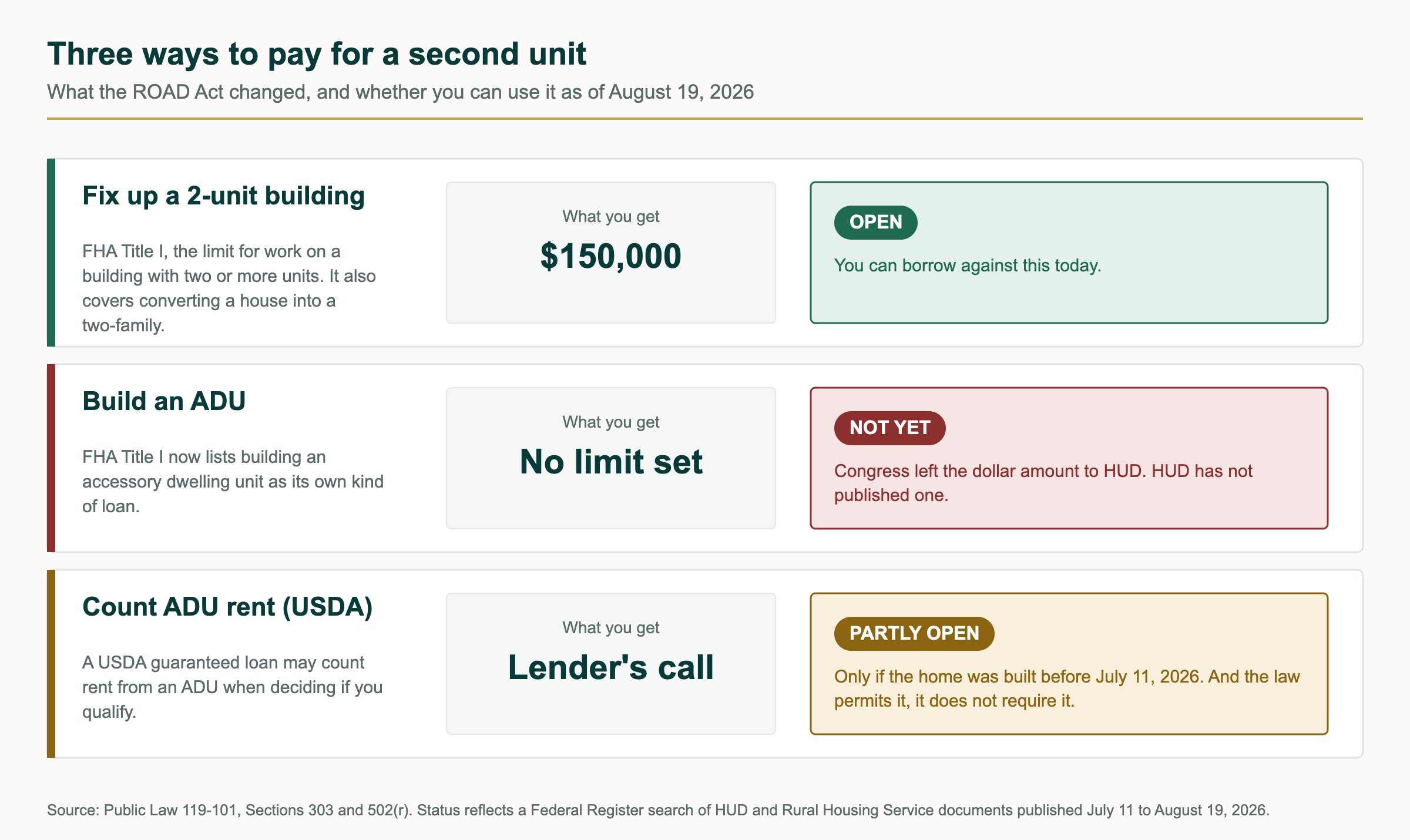
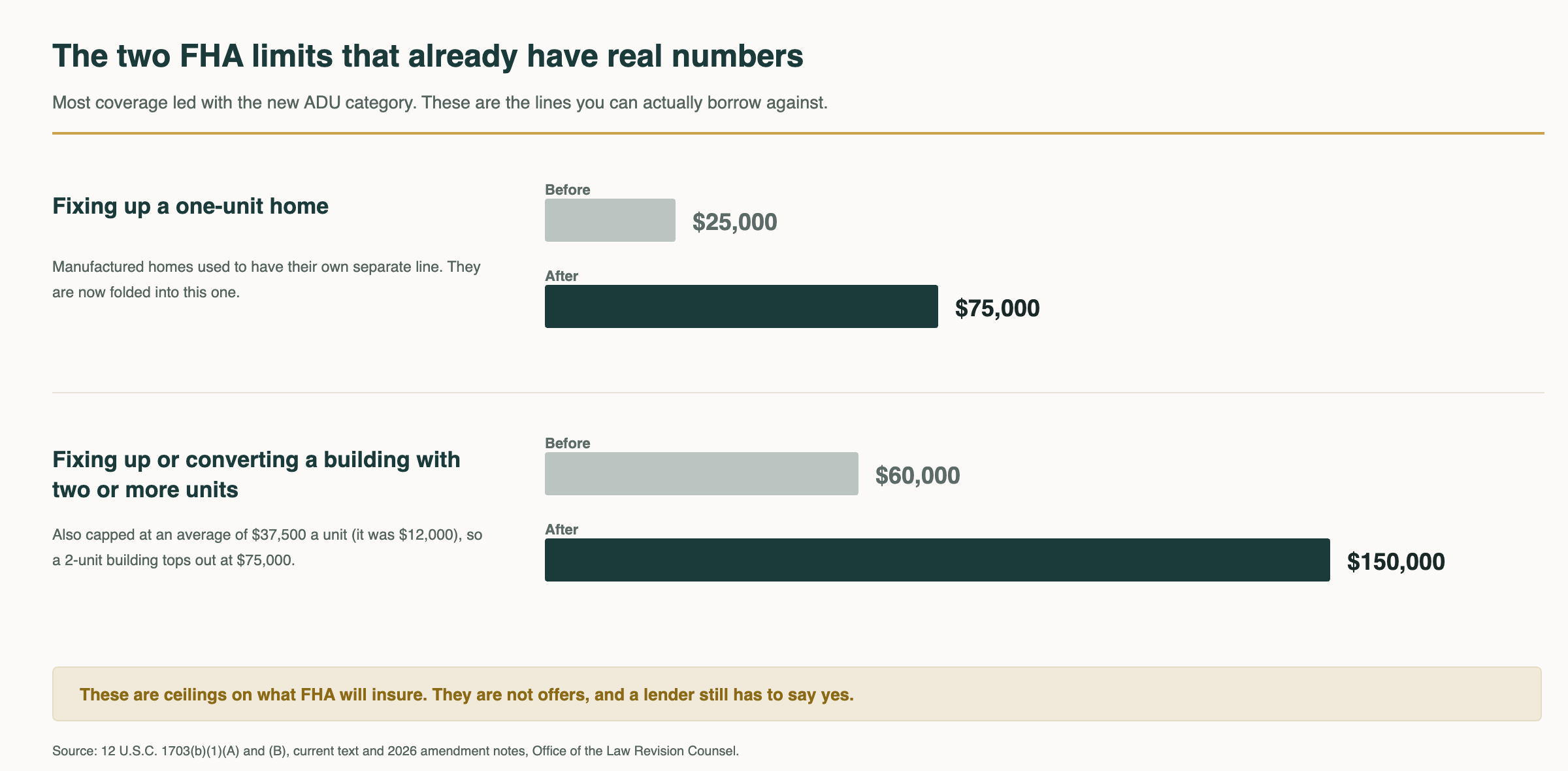
The ROAD Act made building a backyard unit its own kind of FHA loan and let USDA lenders count rent from one. Neither is usable yet: HUD has not set a dollar amount. The quieter change is the home improvement limit, which the law tripled on paper: $75,000 for a one-unit home, up from $25,000, and $150,000 for a building for two or more families, up from $60,000, once HUD acts.[S1] HUD’s Title I rules still show the old limits and terms, so confirm with a Title I lender first.
Published August 19, 2026. This post covers Section 303 and Section 502(r) of Public Law 119-101, enacted July 11, 2026, with a note on Section 209. The statute is quoted from the current text of 12 U.S.C. 1703 and 42 U.S.C. 1472(h)(4) published by the Office of the Law Revision Counsel.
I own half of a duplex and rent out the other half. An ADU, which is short for accessory dwelling unit, is the same idea one step smaller. It is a second place to live on a property that already has a house on it. A basement apartment, a converted garage, a small building in the back yard.
The two questions this answers
The two questions I get asked are always the same. Can I borrow money to build one? And will a lender count the rent before the rent exists? The ROAD Act moved both answers. Not as far as the headlines suggest.
This is the fourth piece in my walk through the law. The first three covered the investor ban that quietly includes duplexes, why small mortgages are hard to get, and the chassis rule for manufactured homes.
The short version
There are three routes here. Only one of them is open today.
The new ADU loan has no dollar amount in it
FHA Title I is the federal program used for home improvements and manufactured homes. The law lists the most you can borrow for each purpose. The ROAD Act added a new line to that list:
(H) such principal amount as the Secretary may prescribe if made for the purpose of financing the construction of an accessory dwelling unit.
12 U.S.C. 1703(b)(1)(H), added by Public Law 119-101, Section 303
Read that next to the lines around it. One says $75,000. The next says $150,000. The rest name real figures too. Only one other line on the whole list is written the way this one is, and it covers fire safety equipment in nursing homes.
So the ADU loan is real, and it is empty. HUD has to fill in the number.
HUD has not filled it in
I searched the Federal Register for anything HUD has published since the law took effect that mentions accessory dwelling units and Title I. There is nothing. The rulebook at 24 CFR part 201 still shows the old amounts and the old loan terms.
As of October 6, 2026, several agencies have published notices under other parts of the ROAD Act, but HUD has published none on the Title I limits or the ADU amount.
If you see a headline saying FHA now pays for ADUs, it is right about the law and early about the loan. There is no amount and no lender guidance to point a builder at. As of October 6, 2026, HUD has published no notice setting the Title I ADU amount.
The change closest to usable today
The useful part of this law for someone who already owns is not the new ADU line. It is the two limits that already had numbers and got much bigger in the law. HUD has not yet updated its Title I rules to match, so confirm with a Title I lender before you plan around them.
Three things there are worth slowing down on.
- The second bar is the one to notice. That limit covers work on a building used, or about to be used, as a home for two or more families. Turning a single-family house into a two-family building counts. It is a different way to get to the same place as an ADU, and it has a number in the statute today.
- Loan length matters more than the ceiling. The law lets HUD set terms of up to 30 years, but HUD has not done so yet. The old rulebook capped home improvement loans at 20 years and a month. If HUD adopts a 30-year term, stretching $75,000 over 30 years instead of 20 would lower the payment.
- These are ceilings, not offers. This part of the law tells FHA when it may not insure a loan. It does not make any lender give you one. Your credit, income and equity still decide.
The USDA rule, read carefully
USDA guarantees home loans in rural areas. Section 502(r) does two separate things to that program. The second one is where most summaries go wrong.
First, it defines what an ADU is
For the first time, this program has a definition written into federal law. Four conditions, and all four have to be true.
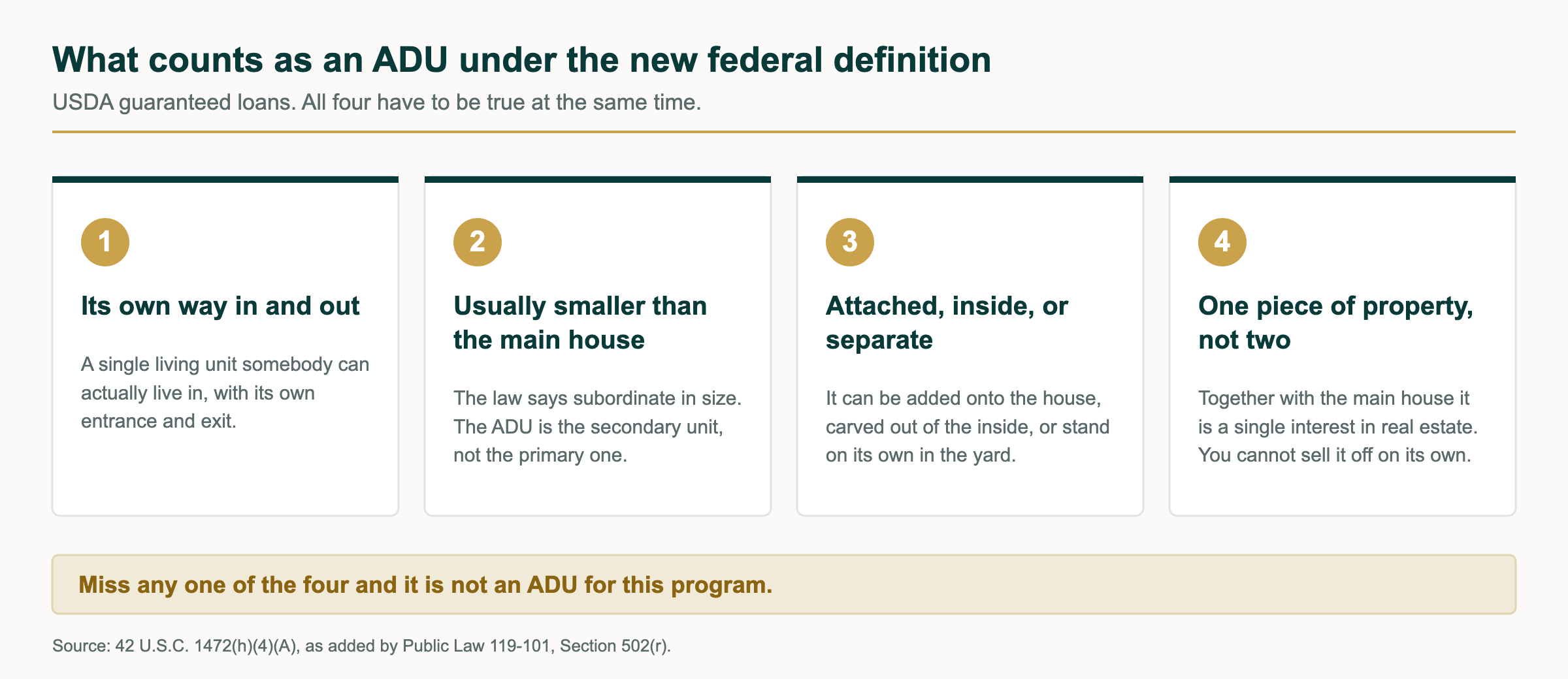
The fourth one catches people. A single interest in real estate means the ADU is not its own lot. You cannot sell it separately. If your plan is to split the property later and sell the back unit, this definition does not describe what you are building.
Second, it says the rent may count
Nothing in this paragraph shall be construed to prohibit the leasing of an accessory dwelling unit or the use of rental income derived from such a lease to qualify for a loan guaranteed under this subsection, (i) after the date of enactment of the 21st Century ROAD to Housing Act; and (ii) if the property that is the subject of the loan was constructed before the date of enactment of the 21st Century ROAD to Housing Act.
42 U.S.C. 1472(h)(4)(C), added by Public Law 119-101, Section 502(r)
There are two traps in that sentence.
Trap one: the date applies to the house, not the ADU
Look at the words: the property that is the subject of the loan was constructed before the date of enactment. That date is July 11, 2026. So this helps people buying an existing home. A house built after July 11, 2026 never gets this treatment, even if the ADU goes up years later. The rule shrinks over time instead of growing.
Trap two: it permits, it does not require
The sentence says nothing shall be construed to prohibit. That clears an obstacle out of the way. It does not tell a lender to count the rent, how much of it to count, or what paperwork to ask for. USDA has published nothing on it yet. If you want to use this, the person to ask is an approved lender, and the question is whether their own rules allow it yet.
Your city still decides
None of this matters if your city will not let you build the unit. That is local law, and this federal law does not override it.
What Section 209 actually does
What it does instead is Section 209. It lets HUD give money to cities and counties to adopt pre-approved building plans, sometimes called pattern books. These are designs the city has already checked against its own rules, so anyone using one skips much of the review. The law names what those designs can cover, and the list starts with accessory dwelling units, then duplexes, triplexes, fourplexes and townhouses.
Why the dullest section may matter most
This is the dullest part of the law and it might change the most for someone actually trying to build. Waiting on permits costs real money. Two limits to keep in mind: the money can only pay for choosing the designs, not for construction, and this section does not set aside any specific amount of funding.
What this does not do
- It does not give you an FHA ADU loan you can apply for. The loan exists in the law with no dollar amount. HUD has to publish one first.
- It does not spend any money. Section 1202 authorizes no additional funds, and the Congressional Research Service reports that the Act appropriates money for no section.
- It does not override zoning. Whether an ADU is allowed on your lot is still a local decision.
- It does not help new construction on the USDA side. The house has to have been built before July 11, 2026.
- It has not changed the rulebook yet. 24 CFR part 201 still shows the old amounts and the old 20 year term cap.
What I am watching
One document decides most of this. It is the HUD notice that fills in the missing dollar amount. Until it exists, an FHA financed ADU is a category and not a product.
HUD also owes a method for adjusting all these limits every year, due by July 11, 2027. Over ten years, how that method works will matter more than this one-time increase does.
What I am watching next
The second thing I am watching is quieter. The two-unit limit already has a number, and it already covers converting an existing house. So the first real wave of second units financed under this law may get booked as conversions rather than as ADUs. If that happens, it will not look like an ADU story in the data at all.
The diagrams in this post are free to republish with attribution. Copy-paste embed code is on the charts page.
Whether you are adding a unit or buying a building that already has two, the math is the same. What you pay each month against what the property brings in. The free house hacking calculator takes a price, a rent and your loan terms and gives you your real monthly cost. No account and no email required.
Common questions
Can I get an FHA loan to build an ADU right now?
Not in practice yet. The ROAD Act made building an accessory dwelling unit an eligible purpose under FHA Title I and gave it its own loan category. But Congress wrote that category as such principal amount as the Secretary may prescribe, without naming a figure. HUD has not published the limit, and the rules at 24 CFR part 201 have not been updated. A regular Title I improvement loan, capped at $25,000 under current HUD rules, is an option where a lender offers it.
How much can I borrow to improve a home under FHA Title I now?
In the statute, the limit for improvements to an existing one-unit home is now $75,000, up from $25,000. For work on, or conversion into, a building for two or more families, the statute now says $150,000, up from $60,000, with the per-unit average rising from $12,000 to $37,500. These are caps on what FHA will insure, not amounts a lender has to offer, and HUD can reset them. HUD has not yet updated its Title I rules at 24 CFR part 201, which still show the old amounts and a 20-year term, so confirm with a Title I lender before you plan around them.
Can USDA count my ADU rent when I apply for a loan?
The ROAD Act says nothing prohibits leasing an accessory dwelling unit or using the rent from it to qualify for a USDA guaranteed loan. It applies only where the property was constructed before July 11, 2026. Because the law permits this rather than requiring it, each lender decides whether and how to apply it. Ask an approved lender directly.
What counts as an accessory dwelling unit under the new federal definition?
For USDA guaranteed loans, an ADU is a single livable unit with its own way in and out, usually smaller than the main house, that can be attached to, built inside, or detached from a one-unit single-family home, and that together with the main home is a single interest in real estate. That last part means it cannot be sold as a separate property.
Does the ROAD Act let me build an ADU if my city does not allow them?
No. The Act does not override local zoning. Section 209 lets HUD fund cities that adopt pre-approved designs for ADUs, duplexes and similar buildings, which shortens permitting where a city takes part. But that money cannot pay for construction, and the section sets aside no specific funding.
What is an ADU?
An accessory dwelling unit, or ADU, is defined as a self contained secondary home on the same lot as a primary residence, with its own kitchen, bathroom and entrance.
Get started with the newsletter!
Useful, relevant analysis, tools, tricks, and what you need to know on the journey to financial freedom. From the van years to a duplex, the plain math and none of the hype.
Subscribe and get the free $0-to-First-Property Roadmap to start.
No spam. Unsubscribe in one click.
Want the deeper toolkit? The guides and spreadsheets are in the shop, from $5, and the free tools stay free either way.
Sources
- 21st Century ROAD to Housing Act, Public Law 119-101, U.S. Government Publishing Office. Sections 209, 303, 502(r) and 1202 are the basis for this post.
- 12 U.S.C. 1703, Insurance of financial institutions, Office of the Law Revision Counsel. Current text of the Title I limits and terms, with the 2026 amendment notes recording the old figures.
- 24 CFR 201.11, Loan maturities, Legal Information Institute. The 20 year and 32 day cap that has not yet been updated.
- Federal Register. Searched for HUD and Rural Housing Service documents published July 11 through August 19, 2026 referencing accessory dwelling units and Title I. No implementing documents found.
- [S1] uscode.house.gov, laws in effect on September 22, 2026; Pub. L. 119-101 s303(a)(1), July 11, 2026, read 24 September 2026: “12 U.S.C. 1703(b)(1)(B): "$150,000 or an average amount of $37,500 per family unit if made for the purpose of financing the alteration, repair, improvement, or conversion of an existing structure used or to be used as a dwelling for two or more families;"…” uscode.house.gov.
- [S2] Electronic Code of Federal Regulations, eCFR up to date as of 9/22/2026; section last amended 61 FR 19796, May 2, 1996, read 24 September 2026: “The term of a manufactured home loan shall be not less than six months and not more than 20 years and 32 days from the date of the loan" (24 CFR 201.11, up to date as of 9/17/2026); "Single family property improvement loans—$25,000, except that a loan for…” www.ecfr.gov.